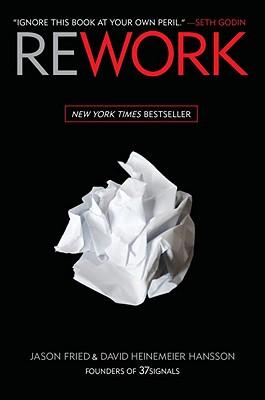
Written by the founders of Basecamp, this short, punchy book challenges a lot of conventional startup wisdom — that you need a big plan, outside funding, or to work punishing hours to build something real. Each chapter is a short, standalone argument, easy to read in fragments.
Planning is guessing, and outside money is Plan Z
Fried and Hansson open by attacking the long-range business plan, which they treat as an act of pretend — a document that lets you feel prepared while quietly encoding a stack of assumptions about a future nobody can see. Their alternative is not 'no planning'; it is short, workable plans revisited constantly, on the basis that a three-month bet you can actually see through beats a three-year plan that is obsolete by month four. Call them guesses rather than plans, they argue, and you will hold them more loosely and change them faster.
The same scepticism runs through their treatment of funding. Outside money is Plan Z — not forbidden, but the last option after everything else has failed, because taking it swaps one master for another: investors' timelines, investors' definition of success, and an obligation to grow at a rate the business may not want. Their preferred model is a business that is profitable early and small on purpose, funded by customers rather than rounds. They pair this with a distinction worth keeping: start a business, not a startup. A startup, in their usage, is a business designed to defer the question of whether anyone will pay; a business answers it immediately.
The related chapter — building to flip is building to flop — makes the point that an exit is a strategy for the founders, not for the company, and that businesses built primarily to be sold tend to be worse at the ordinary job of serving customers profitably. Fifteen years on, with a generation of venture-funded companies having discovered what happens when the funding stops, this is the section that has aged best.
Build half a product, not a half-assed product
This is the book's sharpest reframe. Most owners hear 'cut features' as 'ship something worse', and resist it on principle. Fried and Hansson's version is that you cut scope aggressively down to the smallest thing that is genuinely excellent, and ship that: half a product done brilliantly, rather than the whole thing done adequately. Delivered as a design ethic rather than a statistic, it is the same underlying logic as focusing on the small share of features that carries most of the value.
The supporting chapters are the practical machinery for actually doing it. Start at the epicentre: identify the one thing that, if removed, means you no longer have a business at all — for a hot dog stand, the hot dog, not the cart or the condiments — and build that first. Embrace constraints: limited time, money and people force decisions that unlimited resources let you avoid, which is why constrained projects often ship better products. Ignore the details early on, because agonising over the precise shade of a button before the thing works is procrastination wearing a designer's hat. And making the call is making progress: an imperfect decision now beats a perfect one later, and most decisions are temporary anyway.
There is a matching argument about estimates that any owner who has ever quoted a job will recognise. Estimates are unreliable and get worse the larger the thing being estimated, so the fix is not better guessing but smaller pieces — break the work down until each part is small enough that being wrong about it does not matter much. Their other rule in this vein: long lists do not get done. A backlog of two hundred items is a guilt generator rather than a plan, and cutting it to what you will actually do this month loses nothing except the guilt.
Workaholism is a process problem wearing a badge
Written years before hustle culture attracted its own backlash, Rework got there early. Long hours, the authors argue, are usually a symptom of a broken process or unclear priorities rather than evidence of commitment, and workaholics create a culture where people compete on hours rather than results — which quietly punishes the efficient. A business that runs on its founder's exhaustion has a fragility built into it that no amount of extra effort resolves.
The chapters on how work actually gets ruined are the most immediately usable in the book. Interruption is the enemy of productivity: real work needs long, uninterrupted stretches, and a day chopped into fragments by meetings and messages is not a shorter working day, it is a day with almost no work in it. Meetings are toxic, and their arithmetic is worth repeating — a one-hour meeting with eight people costs eight hours of company time, not one. ASAP is poison: if everything is urgent, urgency stops meaning anything and you lose the ability to signal a genuine emergency.
On people, they are equally blunt. Hire when it hurts, not in anticipation — do the job yourself first so you know what you are actually hiring for, and add someone only when the pain of not having them is real. Hire managers of one: people who set their own direction and do not need supervising into motion. Hire great writers, because clear writing is the visible evidence of clear thinking and matters more in a business run largely through text than most job adverts admit. And send people home at five, because someone with a full life outside work brings more to it, not less.
Out-teach your competition
The marketing section is where Rework has aged into conventional wisdom, largely because it was right. Their argument is that a small company cannot outspend anyone on advertising, so it should compete on generosity instead: teach what you know, publicly and for free, until the audience you have built is worth more than the ad budget you never had. Emulate chefs — a chef publishes the recipes and still fills the restaurant, because the value is in the execution and the relationship, not in the secret. Sell your by-products: the things you make on the way to making your product, from the process you developed to the book about how you work, are often saleable in their own right.
Marketing is not a department is the load-bearing claim. Every email, every invoice, every apology, every phone call answered on the second ring is marketing, which means it cannot be handed to one person with a budget. Underdo your competition: deliberately do less than the incumbents, better, rather than matching them feature for feature and ending up as an inferior copy. Pick a fight — position yourself against something specific, because standing for something means standing against something, and it gives customers a reason to care. And build an audience before you need one, so that when you launch you are speaking to people rather than shouting at strangers.
The closing section on culture supplies the quiet counterweight to all the contrarianism. Culture is not a table-tennis table or a values poster; it is the accumulation of consistent behaviour, and it cannot be installed by announcement. Do not scar on the first cut — the instinct to write a new policy every time something goes wrong turns a company into a rulebook written by its worst days. Own your bad news, deliver it yourself and deliver it fast, because the version you tell is always better than the version invented in your absence. And say no by default, on the basis that every yes is a permanent obligation while a no is only a temporary disappointment.
Key lessons
- Plans are guesses — long-term business plans often waste effort on assumptions that won't survive contact with reality anyway.
- You don't need outside funding to build a real, profitable business, and taking it changes the business's incentives.
- Workaholism is not the same as effectiveness; long hours are frequently a symptom of a broken process, not dedication.
- Build half a product, not a half-assed product — cut scope aggressively rather than compromising on quality.
Most of the conventional wisdom about how you 'have to' build a business — funding, five-year plans, relentless hours — is optional, and often actively counterproductive.
What this means for a UK small business
The half-a-product principle is the single most transferable idea here for a UK owner about to launch a new service, menu or product line: pick the smallest genuinely excellent version and ship it, rather than delaying for six extra features nobody asked for. It is cheaper, it gets real customer feedback sooner, and it avoids the trap of a launch date that keeps slipping because the list keeps growing.
The workaholism chapters land hard against UK small-business culture, where a sixty-hour week is often worn as proof of seriousness. Before you hire someone to absorb the hours, Rework's uncomfortable question is whether those hours exist because of volume or because of a broken workflow — hiring into a bad process just gets the bad process done faster, and adds employer National Insurance, pension contributions and a rota to manage on top.
The out-teach-your-competition chapters are the practical route for a UK trade or professional firm with no advertising budget: publish what you know, with the real answers rather than gated teasers, and the enquiries follow. Two cautions, though. Outside money is Plan Z is easier advice for a software firm than for a business buying stock, vans or plant, where a finance facility may be the difference between taking a contract and turning it down. And say no by default is a luxury of having enough demand to refuse some of it.
What’s aged well
The scepticism towards funding-at-all-costs and hustle culture has aged well as those trends have themselves come under more scrutiny.
What feels outdated
A handful of references are dated, but the short, standalone-chapter arguments remain sharp.
Where it falls short
The book's confidence is also its weakness: sweeping, punchy claims with no room for exceptions, when in truth some businesses genuinely do need outside capital, some do need to grow fast to hold a competitive position, and some cannot cut scope the way a software company can — a restaurant cannot serve half a meal brilliantly. Basecamp is the recurring case study and it is an unusually comfortable example: a high-margin software business with no stock, no premises network and no rota to fill.
The format cuts both ways too. Standalone essays of a page or two make it easy to read in fragments, but nothing gets argued past the first punchline, and a fair amount is assertion rather than evidence. Treat it as a corrective to the conventional wisdom you already carry, not as a system to implement.
The Business Stuff verdict
Quick, contrarian and genuinely useful as a counterweight to more conventional growth-obsessed business advice.
Three things to actually do after reading it
- Cut your current business plan down to what you'd actually bet on for the next three months, and shelve the rest.
- Identify one process currently being fixed with 'work harder' rather than 'work differently', and redesign it.
- Cut scope on your next project until what remains is genuinely excellent, rather than everything at mediocre quality.
If you liked this, read next
Five similar books
- Company of One (Paul Jarvis)
- The Toilet Paper Entrepreneur (Mike Michalowicz)
- Essentialism (Greg McKeown)
- The 4-Hour Workweek (Tim Ferriss)
- It Doesn't Have to Be Crazy at Work (Jason Fried & DHH)
Common questions
Is Rework still relevant fifteen years on?
More than it was when published. Its scepticism about outside funding, growth for its own sake, hustle culture and building a company to flip all read as contrarian in 2010 and as fairly mainstream now, largely because a generation of venture-funded businesses have since demonstrated what happens when the money stops. The chapters on out-teaching your competition anticipated content marketing before that was a phrase anyone used. What has dated is mostly incidental — a few technology references, and a workplace picture drawn before remote work became normal. The ideas are still sharp; it is a two-hour read, and the standalone one-page chapters mean you lose nothing by skipping the ones that do not apply to you.
What does 'build half a product, not a half-assed product' mean in practice?
It means cutting scope rather than cutting quality. Say you are launching a new service and the plan has eight elements. The instinct is to deliver all eight at a passable standard by the deadline. Fried and Hansson's version is to work out which one or two elements are the reason anyone would buy at all, deliver those to a standard you would happily be judged on, and launch without the rest. You find out sooner whether customers want it, you spend less finding out, and you escape the launch date that keeps slipping because the list keeps growing. The test they suggest is the epicentre: remove the thing, and if you still have a business, it was not essential.
Is 'meetings are toxic' just an excuse to avoid talking to each other?
Their objection is to cost, not conversation. A one-hour meeting with eight people is eight hours of company time, not one, and if those people bill at £45 an hour the weekly status meeting is costing roughly £360 a week, or a little under £18,000 a year, for information that could have been three paragraphs in writing. Add the fragmentation cost — a meeting at 11am ruins the two hours before it as much as the hour itself — and the case becomes hard to argue with. The practical version is not banning meetings but pricing them: invite fewer people, set an actual decision to be made, and default to writing when there is no decision.
Should I really never take outside investment?
Their position is that outside money is Plan Z, not that it is forbidden — the last option after everything else has failed, because it swaps customers for investors as the people you actually answer to. That is easier advice for a software business with high margins and no stock than for a firm that has to buy vans, plant or inventory before it can earn anything, where a finance facility can be the difference between taking a contract and turning it down. The useful part is the question underneath: are you raising money because the business genuinely cannot fund the next step from its own trading, or because raising money feels like progress? Those produce very different decisions.