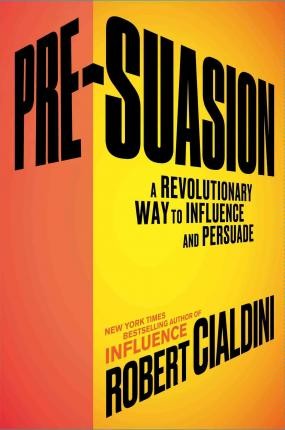
Cialdini's follow-up to Influence shifts focus to the moment just before a persuasive attempt — what you get someone thinking about right before you ask — arguing that the right 'privileged moment' of attention can make a message far more persuasive before a single argument is even made.
The privileged moment
Cialdini's first book, Influence, was about the content of a persuasive message — the levers that make a request more likely to be granted. Pre-Suasion is about the seconds before the request, and his claim is that a surprising share of the outcome is settled there.
He calls it the privileged moment: a window in which whatever someone happens to be focused on shapes how they receive what comes next, independently of the merits of what comes next. His definition of pre-suasion is the process of arranging for recipients to be receptive to a message before they encounter it. The same pitch, the same price and the same request land differently depending on what preceded them — and the preceding thing is frequently something the recipient would never identify as part of the pitch at all.
The example that makes the case cleanest is an experiment run on an online furniture retailer. Visitors arriving at a landing page with a background of soft clouds went on to prioritise comfort in the sofas they browsed and bought; visitors arriving at the identical shop with a background of small coins prioritised price. Both groups, asked afterwards, denied the background had influenced them at all. Nothing about the products, the copy or the prices had changed. Only the thing they had looked at for a moment beforehand.
The book's origin explains its angle. Cialdini spent years embedded, largely undercover, inside the training programmes of professional persuaders — sales operations, fundraisers, recruiters — watching what the genuine top performers did differently. His finding was that the best ones were not better at the pitch. They spent noticeably more of their effort on what happened before it: on framing, timing, and what they got the other person thinking about first. That observation is the whole thesis, and it is a reasonable answer to the obvious objection that this is just priming with a new name.
Cialdini's explanation of why this happens is the most useful single idea in the book: whatever we are attending to at a given moment feels, to us, more important and more causal than it actually is. Directing attention is therefore not a preliminary to persuasion. It is a large part of the mechanism.
Attention is importance, and attention is causality
The strongest chapters establish two claims about attention, and they build on each other.
The first is that channelled attention manufactures perceived importance. Getting someone to focus on a single attribute — safety, speed, cost, provenance, sustainability — temporarily inflates the weight that attribute carries in their decision, without a single argument having been made for it. This is why the question a survey asks first changes the answers to every question that follows, and why a sales conversation that opens on reliability is a different conversation from one that opens on price, even when the identical facts get covered in both.
The second claim is more unsettling: focus creates the appearance of cause. Cialdini draws on research into videotaped police interrogations, where the camera angle determines where the viewer's attention rests. When the camera points at the suspect, observers judge the confession more voluntary and the suspect more guilty than when the same interrogation is shot with the officer in frame, or with both parties given equal weight. The effect shows up in judges and law-enforcement professionals, not only in undergraduates. Whatever is focal reads as causal — with real consequences for how any of us assign blame, credit and responsibility inside an organisation.
The corollary Cialdini draws for business is uncomfortable but honest. If your marketing succeeds in making people focus on your product, they will tend to rate it more highly, and that effect is partly independent of whether the product deserves it.
Openers: attractors and magnetisers
If attention is the currency, the practical question is how to capture it and then keep it. Cialdini splits the tools in two.
Attractors pull attention automatically: the sexual, the threatening and the different. He is more interested in the second group — magnetisers, which hold attention once it has been captured — and three of these work reliably. The self-relevant: anything connected to us personally holds us, which is why a question about the reader outperforms a statement about the seller. The unfinished: work left incomplete stays mentally live, an effect that runs from the classic finding that waiters remember unpaid orders and forget them the moment the bill is settled, through to why a cliffhanger works. And the mysterious: a genuine puzzle compels engagement, because the mind resists leaving an open question alone.
The practical advice Cialdini gives writers and presenters follows directly. Open with a mystery rather than a conclusion — pose a real puzzle, let the audience sit inside it, then resolve it — because an audience that has been holding the question processes the answer far more deeply than one handed the answer first.
It is worth working one sequence through, because this is an idea that is easy to agree with and hard to actually do. Say you are a joiner about to quote £4,800 for a fitted study, and your real advantage is that you turn up on the day you said and leave the place clean. The pre-suasive move is not in the quote at all; it is in the ten minutes before it. Ask what went wrong with the last trade they used, and how far over the job ran. Once the customer has said 'three weeks late' out loud, reliability is the criterion sitting at the front of their mind — and your £4,800 is now being weighed against a £4,200 quote from someone whose reliability has become an open question rather than an assumption. Then put two dated references above the price in the document rather than below it. The figures are illustrative, but the ordering is the whole technique: same quote, same job, different thing in the customer's head when the number lands.
The application that gets quoted most involves getting people to briefly self-identify with a trait before the ask. In one study he describes, researchers approached shoppers for help; a control group was simply asked, while others were first asked whether they considered themselves helpful, or adventurous, depending on what followed. Having just said yes to being that kind of person, agreement rates rose sharply. Nobody's underlying personality changed in those three seconds. Only which part of it was live.
Associations, and the seventh principle
The second half connects pre-suasion back to Influence. Cialdini's argument is that his classic principles — reciprocity, liking, social proof, authority, scarcity and commitment — are not competitors to pre-suasion but its beneficiaries. Each works considerably harder when the privileged moment has been arranged first. He also gives a nice account of association as the underlying engine: language, imagery and setting all carry associations that transfer to whatever sits next to them, which is why the background music, the venue and the metaphors in your proposal are doing work whether or not you chose them deliberately.
He then adds a new principle, developed here for the first time: unity. Liking is about similarity — we say yes to people who are like us. Unity is stronger and categorically different: it is shared identity, the sense of being of the same thing rather than merely resembling it. Family, place, and the identities built by acting together all produce it, and Cialdini's case is that unity generates the largest effects of any of his principles, because a request from someone inside your own identity barely registers as a request from someone else at all.
There is a neat inversion in the same section that most readers miss: pre-suasion works on yourself. Cialdini describes deliberately arranging his own working environment so that the cues around him prime the kind of work he wants to do — writing surrounded by things that signal careful scholarship, and doing a different sort of work in a different setting entirely. The claim is that if a stock photograph of clouds can shift a stranger's furniture preferences, whatever is on the wall in front of you all day is doing something to what you produce, and you may as well choose it.
The book closes on ethics, and his case is pragmatic rather than moralising. He presents research suggesting organisations that use dishonest influence pay for it in ways that never appear in the campaign's own numbers: they attract and retain dishonest employees, and they lose good ones. Dishonesty, in his framing, is a tax on your own culture — levied later, and collected by someone else in the building.
Key lessons
- What someone is focused on right before a request shapes how they respond to it, often more than the request's actual content.
- Priming a relevant concept or association just before an ask can measurably increase agreement.
- Attention is a genuinely scarce resource, and directing it deliberately toward the right idea beforehand is a distinct skill from making a good argument.
- Associations built through unrelated cues (colours, words, environment) can measurably shift decisions, even when consciously irrelevant.
Persuasion doesn't start with the pitch — it starts with what you get someone thinking about right before it, and that 'privileged moment' can be deliberately engineered.
What this means for a UK small business
The immediately usable version of this is an audit almost no UK small business site has ever had: what does a visitor look at, read or think about in the fifteen seconds before your price appears? A quote that follows a page of case studies and guarantees lands differently from the identical quote that follows a comparison table. If the first screen of your homepage is a stock photo of a handshake, it is priming nothing at all — which is its own kind of answer.
The same applies to the first two minutes of a sales call. Whatever you ask about first becomes the criterion the customer weighs most heavily for the rest of the conversation. So if your genuine advantage is response time rather than price, ask them about their last supplier's response time before you discuss anything else.
Unity has the most headroom for community-rooted UK firms — the family practice, the local trades business, the accountant who only works with one trade. 'We're from here too' and 'we only do this, and you are one of us' are identity claims rather than likeability claims, and Cialdini's evidence says identity is the stronger lever by some distance. It only works if it happens to be true.
What’s aged well
Builds on well-established priming research and remains current.
What feels outdated
Nothing significant given relatively recent publication.
Where it falls short
Pre-Suasion sits, unavoidably, in the part of social psychology that has had the hardest decade. Several of the priming effects it treats as settled belong to a literature — subtle unconscious social priming — that has struggled badly with replication since the early 2010s, and Cialdini has himself publicly acknowledged the problem in that field. The book's format compounds it: one vivid study per point, no effect sizes, no failed replications, and no sense of how large or how durable any of it is outside a laboratory.
It is structurally baggy as well. The final third is largely a recap of Influence with pre-suasion bolted on, which makes it hard to read standalone and repetitive if you have read the original. The genuinely new idea — arrange the moment before the ask — is a long article's worth of material stretched to book length.
The Business Stuff verdict
A worthy, well-researched follow-up to Influence — best read after the original, not instead of it.
Three things to actually do after reading it
- Before your next important ask, consider what you want the other person focused on in the moments right before it.
- Review your sales page or pitch for what it primes the reader to think about before the actual offer appears.
- Test changing the framing or context immediately preceding a call to action, not just the call to action itself.
If you liked this, read next
Five similar books
- Influence (Robert Cialdini)
- Predictably Irrational (Dan Ariely)
- Nudge (Thaler & Sunstein)
- Thinking, Fast and Slow (Daniel Kahneman)
- Made to Stick (Chip & Dan Heath)
Common questions
Do you need to read Influence before Pre-Suasion?
Yes — read Influence first. Pre-Suasion is explicitly a companion volume and assumes you already know Cialdini's six principles of influence, to the point that its final third is largely a recap of them with the pre-suasion idea attached. Read cold, that section feels like a summary of a book you have not read; read after Influence, it feels repetitive. Influence is also the better book on its own terms: older, more thoroughly replicated in its core claims, and more directly useful. The sensible order is Influence, then a gap of a few months while you actually use it, then Pre-Suasion if you want the idea about timing and attention.
Has the psychology in Pre-Suasion held up?
Partly, and you should read it knowing which bits are which. The book leans on social priming — the idea that an incidental cue quietly shifts later behaviour — and that specific literature has had a rough decade, with several famous findings failing to replicate since the early 2010s. Cialdini has publicly acknowledged the replication problems in his own field. The broader, less exotic claim is on firmer ground: what someone has just been thinking about affects how they read what you say next, which is close to how attention and memory are understood to work generally. Take the central argument seriously and treat the individual studies as illustrations rather than proof.
What does a 'privileged moment' look like in a real business?
It is the thirty seconds before you make your ask, and it is mostly about what you put in the reader's head first. A roofer who opens a quote by saying most of the callouts this winter were on flat roofs that had not been checked in five years has framed the price as insurance before the number appears. An accountant who asks what a lost week at year end would actually cost has set the reference point before quoting a fee. The mechanic is simple: raise the thing your offer solves, in the customer's own terms, immediately before you name the terms. Not a trick sentence — just deliberate ordering.
Is pre-suasion manipulation?
It can be, and Cialdini spends a chapter on exactly that. His position is that these techniques are amplifiers rather than arguments: they make a true claim land harder, and they make a false one land harder too. His practical rule is that you should only direct attention toward something genuinely present in the offer — real risk, real benefit, real evidence — because manufactured associations are both dishonest and commercially fragile once customers notice. He also argues the cost of manipulation shows up in the organisation before it shows up in the market, as it selects for staff who are comfortable doing it. The test is simple enough: would you be happy explaining the sequence to the customer afterwards?