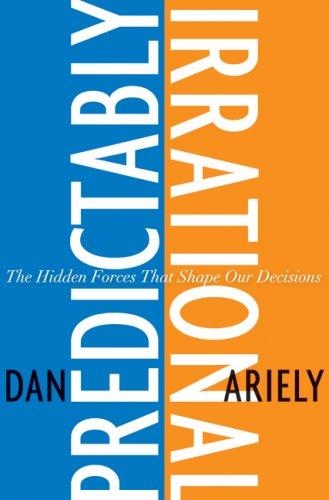
Ariely presents a wide range of his own behavioural economics experiments showing that people don't make decisions the way classical economics assumes — irrationality isn't random, it's systematic and predictable, which means it can be understood, anticipated, and in some cases designed for.
Irrationality has a pattern
Ariely's opening move is to dismantle the assumption underneath most economics and nearly all pricing: that people weigh costs and benefits consistently and know what things are worth to them. His evidence is his own lab work rather than borrowed research, and the conclusion is more useful than the flat claim that people are irrational. The irrationality is systematic. The same mistakes recur in the same direction across almost everyone tested, which means — unlike random error — they can be anticipated, and designed around, and designed with.
The book has an origin story that explains its temperament. Ariely was severely burned as a teenager and spent years in hospital, where nurses removed his bandages using the fast-rip method they were certain was kindest. Lying there, he was not certain at all. Years later he ran the experiments and found the nurses' confident, universally held professional intuition was wrong. That is the shape of the whole book: a widely shared belief about how people behave, tested properly, turning out to be backwards — and the people holding the belief having no idea, because nobody ever checks.
Relativity, decoys and anchors
People are poor at judging absolute value and excellent at judging comparisons, so they judge whatever comparison is put in front of them. The Economist subscription experiment is the standard illustration and still the clearest. Offered a web-only subscription at $59, a print-only at $125, and print-plus-web also at $125, students overwhelmingly took the combined deal — while nobody at all took print-only. Remove the pointless print-only option and the majority swung back to the cheap web-only tier. The decoy never had to be chosen. Its entire job was to make the option beside it look obviously sensible.
The anchoring chapters go further and are more unsettling. In one experiment participants wrote down the last two digits of their identification number, were asked whether they would pay that many dollars for a bottle of wine or a keyboard, and then bid for real. The digits, which were meaningless, predicted the bids. Ariely calls the result arbitrary coherence: the first number attached to a thing sets its perceived value, and every judgement afterwards stays neatly consistent with that arbitrary starting point. It is why a business that launches cheap struggles for years to be seen as anything else, and why the first price a client hears from you matters more than every conversation after it.
Related is what he terms self-herding. We queue outside a restaurant because others are queuing, which is ordinary herding — but we also return to a shop because we went there before, treating our own past behaviour as evidence about quality when it may only be evidence about what was convenient once. Habits get read as considered preferences, by the person holding them.
The cost of zero, and the two rulebooks
Free is not the cheap end of a price scale. It is a different category, and Ariely's demonstration is elegantly simple: offered a high-quality Lindt truffle at fifteen cents against a Hershey's Kiss at one cent, most people took the truffle, which is the rational trade. Cut both prices by a single cent — truffle at fourteen, Kiss at nothing — and the crowd flipped to the Kiss. Nothing changed about the relative value. What changed is that one option now carried no possibility of having made a bad deal. Free removes downside risk entirely, and people will walk a long way and queue a long time for something worth almost nothing to get it.
The chapter business owners should read twice is the one on social versus market norms. We run two separate rulebooks. Social norms cover favours, family, community and goodwill: warm, reciprocal, never priced, with the return unspecified and often generous. Market norms cover exchange: explicit, priced, fair, and cold. Both work fine. Mixing them is what causes damage, and the damage is asymmetric — once cash has been introduced, the relationship rarely goes back.
Ariely's evidence is pointed. Asked to give a group of retired people legal advice at a heavily discounted rate, lawyers largely refused; asked to do it free, they largely agreed, because the free version was a favour and the discounted version was an insultingly paid job. In another well-known case, a nursery that introduced a fine for collecting children late saw lateness increase, not fall: parents who had felt guilty about imposing on staff now felt they had simply bought extra time. Removing the fine did not restore the guilt. The social contract had already been converted into a transaction and stayed converted.
Ownership, open doors and the price of expectation
The later chapters catalogue the ways valuation goes astray once we are involved. The endowment effect gets a memorable demonstration through the lottery for Duke basketball tickets: students who won tickets and students who missed out were, by design, otherwise identical, yet winners priced their tickets at a level buyers would not remotely approach — thousands of dollars asked against a couple of hundred offered. Ownership is not a rational adjustment to the same asset; it reliably rewrites what the asset appears to be worth.
Then there is our inability to close doors. In a computer game where players could earn money behind three doors, doors began to disappear if neglected — and players wasted clicks, and real earnings, dashing back to keep dying options alive. Ariely's reading is that we treat a closing option as a loss and pay to avoid feeling it, even when the option was worthless. For an owner, this is the service line nobody buys, kept alive because dropping it feels like retreat.
Finally, expectation. Told in advance that a beer contained balsamic vinegar, drinkers disliked it; served the same beer without warning, they preferred it to the standard version and were annoyed to learn what was in it. The same effect shows up with price and medicine, where an expensive painkiller relieves more pain than an identical cheap one. The lesson is not that perception is everything. It is that what you tell someone before they experience your product becomes part of the experience, and cannot be separated from it afterwards.
Deadlines, temptation and the fudge factor
The chapter with the most immediate practical payoff is the one on procrastination, and Ariely ran it on his own students. One class was given three papers with a single deadline at the end of term. Another was allowed to set its own deadlines, spaced however it liked, with real penalties for missing them. A third had evenly spaced deadlines imposed. The imposed-deadline group did best; the single-deadline group did worst; and among the students who set their own, the ones who chose genuinely spaced deadlines did well while those who optimistically bunched them at the end did badly. The finding is not that people lack willpower. It is that people know they lack willpower, will voluntarily pay for external constraints, and benefit when someone imposes them.
The book's closing theme is dishonesty, and Ariely's argument is that most cheating is not done by a few crooks maximising gain but by a great many people fudging slightly — enough to profit, little enough to keep seeing themselves as honest. His experiments suggested that cheating rose when the thing being taken was a step removed from cash, such as a token exchanged for money moments later, and fell sharply when people were reminded of a moral standard immediately beforehand. Given what has since happened to this strand of his work, treat the direction as a hypothesis worth testing rather than a demonstrated fact — but the underlying idea, that systems should make honesty easy and temptation distant, survives the doubt.
Key lessons
- Relativity drives most pricing decisions — people rarely judge value in isolation, only in comparison to nearby options.
- A 'decoy' option, even one nobody chooses, can measurably shift preference toward a different option entirely.
- The 'zero price effect' — free is qualitatively different from cheap, not just quantitatively — changes decisions disproportionately.
- Social norms and market norms operate by different rules, and mixing them (like paying for a favour) can damage a relationship.
Irrationality in decision-making isn't random noise — it's systematic and predictable, which means smart pricing, offer design and communication has to account for how people actually decide, not how they're assumed to.
What this means for a UK small business
The decoy lesson is directly usable on any price list. Say you offer bookkeeping at £150 a month and a full finance package at £450, and almost everyone takes the £150. Adding a deliberately awkward middle tier — £395 for the full package minus the quarterly review — makes the £450 look like the obvious choice rather than the expensive one. The middle tier is not there to sell. Anchoring matters just as much: whatever number you say first in a quote sets the frame, so leading with the £450 and working down lands very differently from creeping up from £150.
The zero-price effect explains why a genuinely free first meeting outperforms a token £25 one by far more than £25 of demand, and why free delivery converts better than an equivalent discount on the goods.
The two-rulebooks point is the most valuable and the most ignored in UK small business, where favours between owners, suppliers, family and long-standing clients are the norm. Pressing a £50 note on a fellow trader who passed you a job converts a relationship worth thousands into a transaction priced badly, and you will not get the relationship back. Keep favours as favours, price services as services, and never pay a small amount for something that was being given freely.
What’s aged well
The experimental findings remain widely cited and influential in behavioural economics and pricing strategy.
What feels outdated
Nothing significant; the experiments and conclusions remain broadly relevant.
Where it falls short
The honest caveat is now about the author as much as the material. A 2012 paper Ariely co-authored on honesty — not from this book — was retracted in 2021 after the underlying field data was shown to be fabricated. Ariely denies fabricating it, and he has said Duke's investigation concluded he did not knowingly falsify data while faulting his handling of it, but the episode sits over the whole research programme. Set beside that, the experiments here are mostly small student-sample lab studies from the mid-2000s, an era whose social psychology has replicated patchily, and the book rarely distinguishes a robust finding from one striking result. Read it as a source of hypotheses about your own pricing, and test them on your own customers.
The Business Stuff verdict
One of the most readable, immediately applicable behavioural economics books — genuinely changes how you look at pricing and offers.
Three things to actually do after reading it
- Review your pricing tiers for whether a 'decoy' option would clarify the choice you actually want customers to make.
- Check whether you're mixing social and market norms anywhere in customer or team relationships in a way that could backfire.
- Test a genuinely free offer against a very cheap one and notice the disproportionate difference in response.
If you liked this, read next
Five similar books
- Influence (Robert Cialdini)
- Nudge (Thaler & Sunstein)
- Thinking, Fast and Slow (Daniel Kahneman)
- Pre-Suasion (Robert Cialdini)
- The Art of Thinking Clearly (Rolf Dobelli)
Common questions
Can you still trust Predictably Irrational after the Ariely data scandal?
Trust it less than you would have in 2008, and treat it as a source of ideas to test rather than settled fact. The 2021 retraction concerned a later paper on honesty, not the studies in this book, and Ariely denies fabricating the data — but the affair, combined with social psychology's wider replication problems, means no single experiment here should be treated as proven. The good news for a business reader is that the core findings you would actually act on, particularly decoy pricing, anchoring and the zero-price effect, are cheap to test on your own customers, and testing beats trusting either way.
What is the decoy effect and how do I use it on a price list?
A decoy is an option that exists to make another option look good. Ariely's Economist example had three tiers, one of which was priced identically to the best deal while offering less — nobody chose it, but its presence pushed most people to the premium tier. In practice, if you have two prices and everyone takes the cheaper one, the fix is often not a discount but a third option positioned so the one you want to sell becomes the obvious value. Build it honestly: the decoy should be a real service someone could buy, not a fake tier.
What is the difference between this and Thinking, Fast and Slow?
Kahneman's book is the heavyweight — decades of foundational research on two systems of thinking, denser, slower, and more rigorous. Ariely's is lighter, funnier and built entirely from his own experiments, with far more that translates directly into pricing and offer design. If you want to understand how judgement works, read Kahneman. If you want to look at your own price list differently by Thursday, read Ariely. Reading both is not wasteful: they cover overlapping ground from genuinely different angles, and Ariely is the easier entry point by some distance.
Does the power of 'free' really work for small businesses?
Yes, and more strongly than the arithmetic justifies, which is the whole point. A free first consultation, free delivery, or a genuinely free useful tool pulls in far more response than a small charge for the same thing, because free removes any possibility of the customer feeling they made a bad deal. Two cautions. Free attracts people who want free, so pair it with something that filters for intent — a form, a booking, a qualifying question. And never make it fake: an advertised free item hedged with conditions damages trust faster than charging honestly would have.