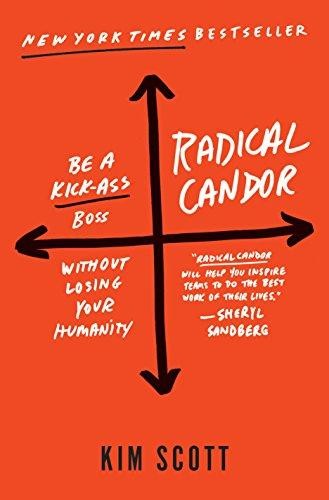
Scott's framework plots feedback on two axes — caring personally and challenging directly — to show why most managers default to either 'ruinous empathy' (caring but avoiding hard truths) or 'obnoxious aggression' (blunt but uncaring). Radical Candor, the sweet spot of both, is presented as a learnable skill with specific, practical techniques.
Two axes: care personally, challenge directly
Scott's framework plots every feedback interaction on two dimensions — how much you demonstrably care about the person as a human being, and how directly you're willing to challenge them — and the argument is that management failure is almost always a collapse on one axis while the other is fine. Most managers aren't cruel. They're decent people who avoid the challenge axis entirely, which Scott names ruinous empathy: prioritising short-term comfort over the harder conversation that would actually have helped.
The two axes produce four quadrants, and the naming is what makes the model stick. Radical candor is both: caring and direct. Ruinous empathy is caring without directness. Obnoxious aggression is directness without care — the boss who tells the truth but makes it a performance. And manipulative insincerity is neither, which is the political, back-channel behaviour that shows up when a manager is disengaged or frightened. Scott's most useful observation about the grid is that you don't get to choose your quadrant; the other person does. It's measured at their ear, not your mouth, which is why the same words land as candour with one person and as an attack with another.
Underneath the grid sits her definition of the job itself, which is worth stating because most owners have never written it down. A manager has three responsibilities: guidance (giving and receiving feedback), team-building (hiring, firing, and working out what each person actually wants), and results (getting things done through other people). Everything in the book hangs off the first, but the point of the list is that none of them are the technical work you were promoted for doing well.
She is also clear that 'care personally' means more than being pleasant. It means knowing what someone actually wants from their working life, which requires conversations most managers never have, and it means being willing to say the difficult thing precisely because you care about where they end up.
Ruinous empathy is the most common, most damaging failure
The sharpest claim in the book is that ruinous empathy — not aggression — is the single most common and most expensive management failure, because it looks exactly like kindness while doing real damage. It's the underperformer who's never told clearly enough to fix the problem. The mediocre work that gets vague encouragement instead of specific correction. The person who spends three years in a role they were never suited to because nobody was honest early enough for it to be fixable.
Scott's own example is the one that gives the book its emotional weight: an employee everyone liked, whose work wasn't good enough, whom she praised for the better part of a year rather than have the conversation — and who, when she finally had to let him go, asked why nobody had told him. That question is the book's thesis. Obnoxious aggression is more visible and gets corrected faster because people complain about it. Ruinous empathy hides in plain sight because it feels good to both parties in the moment and the damage arrives much later.
Her prescription for criticism is deliberately practical: be humble, be helpful, do it immediately, do it in person, praise in public and criticise in private, and — most importantly — make it about the work rather than the person. 'This report doesn't make the argument clearly' is a fixable statement. 'You're not a strong writer' is an identity claim, and people defend identity rather than repair it.
Solicit before you give
The practical starting point isn't giving feedback at all — it's asking for it. Scott's order of operations is solicit, give, gauge, encourage, and the first step is where nearly everybody skips ahead. Genuinely invite criticism of your own leadership, ask a question sharp enough that it can't be dodged ('what could I do or stop doing that would make it easier to work with me?'), then sit through the excruciating silence rather than filling it. Most managers ask once, get nothing, and conclude their team has no complaints.
What you do next determines whether it ever happens again. Reward the candour — visibly, and even when you disagree with it — and then change something and say out loud that you changed it because of what was said. The logic is credibility: a manager who has never demonstrably absorbed hard feedback themselves has no standing to expect their team to take it well from them. It also gives you the fastest possible read on your own blind spots, which is the part most owners are quietly avoiding.
Gauging matters too. Scott's point that the quadrant is judged by the listener means you have to watch how feedback lands — the person who goes quiet, the person who gets defensive — and adjust your delivery rather than concluding they can't handle the truth.
Why the annual review is the wrong container
Scott's other structural argument is that feedback saved up for a formal review is feedback delivered too late to be useful. The unit she wants is two or three minutes, immediately after the thing happened, in the corridor — impromptu, specific, and small enough that neither party has time to build it into an event. Anything worth saying in a review should already have been said, and if a performance conversation contains a genuine surprise, the manager has failed rather than the employee.
She's also unusually direct about the feedback sandwich — praise, criticism, praise — which she treats as a device that exists to make the manager comfortable rather than to help the recipient. It teaches people to stop hearing the praise, since they know what's coming, and it lets the criticism be softened into ambiguity. The alternative isn't harshness; it's separating the two so that praise can be specific and sincere on its own terms, and criticism can be clear enough to act on.
The praise half deserves more attention than it usually gets. Scott argues that vague praise is nearly as damaging as vague criticism, because 'great job' contains no information about what to repeat. Specificity is the respect: telling someone exactly which decision in the meeting was the right one teaches something, and 'well done' teaches nothing.
Rock stars, superstars, and getting things done
One of the less quoted but genuinely liberating ideas is that not everyone wants a growth trajectory, and treating that as a defect causes needless friction. Scott separates superstars — on a steep growth curve, actively seeking more scope, who will leave if not stretched — from rock stars, who are excellent, stable and content where they are, and who hold the team up. Both are essential. The error is managing one as though they were the other: pushing promotion on someone who doesn't want it, or leaving someone who is desperate for a bigger job to stagnate. The fix is an honest career conversation about what the person actually wants over the next few years, rather than assuming.
The final piece is what Scott calls the Get Stuff Done wheel — listen, clarify, debate, decide, persuade, execute, learn — which is her answer to the objection that a candid culture becomes a talking shop. Debate is explicitly time-boxed and separated from deciding, and persuading is treated as a step in its own right rather than something that should be unnecessary once a decision is made. Skip persuasion and you get compliance without commitment, which is how decisions quietly fail in execution.
Key lessons
- Feedback needs both genuine care and direct honesty — either alone produces a worse outcome than both together.
- 'Ruinous empathy' — avoiding hard feedback to protect feelings — is one of the most common and damaging management failures.
- Praise and criticism both need to be specific and sincere; vague versions of either are close to useless.
- Solicit feedback on your own leadership first, genuinely, before asking your team to receive it from you.
The kindest thing a manager can do is give clear, direct feedback — avoiding it to spare short-term discomfort causes far more damage over time.
What this means for a UK small business
Ruinous empathy may be the most common management fault in small UK teams specifically, where relationships are close and the awkwardness feels higher — nobody wants to upset the person they'll be standing next to at the till or on site tomorrow. The result is exactly what Scott predicts: the problem festers until it forces a dismissal, which is a far harder, slower and more expensive process under UK employment law than an honest conversation three months earlier would have been. Documented, specific feedback given early is also, bluntly, what makes a fair dismissal defensible if it ever comes to that.
Soliciting feedback costs nothing and is unusually rare in UK small businesses, where the owner is often assumed to be beyond challenge simply by virtue of owning the place. Asking a team member directly what you should stop doing — and then visibly changing it — buys loyalty and honesty that a pay rise doesn't.
The rock star / superstar split is worth applying before your next round of promotions. In a firm of ten, promoting your best technician into a management role they never wanted is how you lose both a good technician and, eventually, the person.
What’s aged well
The core framework has become a widely referenced standard in management training since publication.
What feels outdated
Nothing significant given its recent publication.
Where it falls short
Scott's career was spent in high-autonomy Silicon Valley tech firms, and several scripts assume a flat, informal, feedback-friendly culture that doesn't transfer neatly to more traditional or hierarchical UK sectors — try 'radical candor' in a family building firm and the framework needs translating, not applying. The two-axis model is also cleaner on the page than in the room: real conversations rarely resolve into 'which quadrant is this', and applying it mechanically produces something that feels like a script rather than the genuine relationship Scott is actually describing. The book is longer than the idea requires, too.
The Business Stuff verdict
One of the most practically useful management books on this list — genuinely changes how feedback conversations go.
Three things to actually do after reading it
- Identify one piece of feedback you've been softening or avoiding, and deliver it directly and kindly this week.
- Ask a direct report for genuine feedback on your own leadership, and actually listen without defending yourself.
- Review your last week of praise — was it specific enough to be useful, or just generic encouragement?
If you liked this, read next
Five similar books
- Extreme Ownership (Jocko Willink & Leif Babin)
- Crucial Conversations (Patterson et al.)
- Multipliers (Liz Wiseman)
- The Culture Code (Daniel Coyle)
- Never Split the Difference (Chris Voss)
Common questions
What does ruinous empathy actually cost a small business?
More than the awkward conversation would have. Picture a £30,000-a-year employee performing at roughly two-thirds of what the role needs, and nobody says so clearly for twelve months. That is around £10,000 of salary buying nothing, before you count the work others quietly redo, the clients who noticed, and the good people who watch underperformance go unaddressed and draw conclusions about the standard here. Then the ending is worse too: dismissing someone who has never had documented, specific feedback is slow, legally exposed and expensive under UK employment law. The honest conversation in month two is cheaper than the process in month fourteen, in every currency including kindness.
How do I give hard feedback without damaging the relationship?
Make it immediate, specific, private and about the work rather than the person. 'That report didn't make the argument clearly — the recommendation was on page four and it needed to be the first line' is fixable. 'You're not a strong writer' is an identity claim, and people defend identity instead of repairing it. Do it within a day or two, in two or three minutes, rather than saving it for a review where it arrives with the weight of an ambush. Ask a question before you deliver a verdict — you may be missing context. And skip the feedback sandwich: it exists to make the manager comfortable, and it teaches people to stop hearing your praise.
Is this workable in a traditional or family business?
Yes, but the language needs translating and the sequence matters more. In a close-knit or family firm the personal-care axis is usually already strong — people genuinely know and like each other — so the missing half is directness, not warmth. Start with the soliciting step rather than the giving step: ask what you should stop doing, sit through the silence, then visibly change something. That establishes it as a two-way habit rather than the owner suddenly announcing a new critique policy. What does not work is importing the Silicon Valley vocabulary wholesale. Nobody in a Lancashire building firm wants to be told they are receiving radical candor.
What if my team says nothing when I ask for feedback?
Expect that the first two or three times, and do not read it as an absence of problems. Silence means the risk of speaking has not yet been shown to be safe. Fix it by asking a sharper question — 'what is the one thing I do that makes your job harder?' is much harder to deflect than 'any feedback for me?' — then stay quiet and count to ten rather than rescuing the moment. When something does come, the response determines whether it happens again: thank them specifically, change one visible thing, and say out loud that you changed it because they raised it.