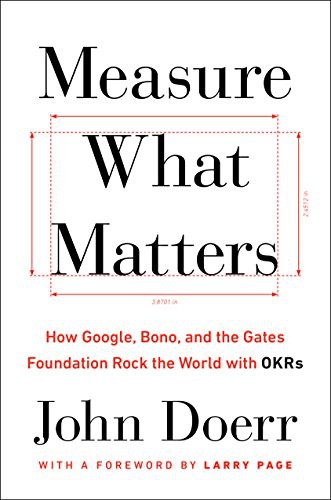
Venture capitalist Doerr, who introduced OKRs to Google in its early days, lays out the system — ambitious Objectives paired with measurable Key Results — through case studies at companies including Google, Intel and various non-profits, arguing that clear, public, regularly-reviewed goals dramatically improve execution.
What an OKR actually is
Doerr's system splits every goal into two jobs that most goal-setting collapses into one. The Objective is qualitative and directional — what you want to achieve and why it matters, written to be memorable rather than measurable. The Key Results are the opposite: a small number of hard, time-bound, numeric outcomes that settle beyond argument whether the Objective happened. Not improve customer service, but cut average first response from 48 hours to four by the end of the quarter.
The discipline in that split is the book's real contribution. Most goal-setting fails at one end or the other: it stays so vague that nobody can tell whether it was achieved, or it becomes a spreadsheet of numbers nobody can connect to any purpose. Doerr's formula — I will achieve a certain Objective as measured by these Key Results — forces both halves to exist together. His other constraints matter as much: three to five Objectives at most, three to five Key Results under each, because a list of fifteen priorities is a list of none. And a Key Result has to be an outcome, not an activity. Publishing twelve blog posts is a task list; adding 500 qualified enquiries is a result.
Two rules make the system work in practice, and they are the two most often dropped. OKRs should be public — visible across the organisation, so anyone can see what anyone else has committed to — and they should be graded honestly at the end of the period rather than quietly forgotten. Doerr's repeated point is that a goal nobody else can see is a wish, and that the mild discomfort of visible tracking does most of the actual work.
Intel, Operation Crush, and the export to Google
The book is part memoir. Doerr learned the system at Intel in the 1970s under Andy Grove, who had adapted Peter Drucker's management by objectives into something faster-cycling and more measurable. The case study he reproduces at length is Operation Crush — Intel's 1980 campaign to defend its microprocessor against Motorola's competing chip, where a single corporate objective was cascaded down through divisions in a matter of weeks, each level writing Key Results that fed the level above. It is the clearest demonstration in the book of what alignment looks like when it works: a young Doerr, then a field engineer, could see precisely how his own targets connected to the company's survival.
In 1999 he presented the same system to Google, then around forty people, and Larry Page and Sergey Brin adopted it early enough that it grew with the company rather than being imposed on it later. The remaining case studies exist to prove the system is not a Google artefact: Bono's ONE campaign, the Gates Foundation, Intuit, the health-data firm Nuna, the schools messaging platform Remind and others. They vary in usefulness, and the smaller organisations are considerably more instructive for most readers than the famous ones.
The four superpowers
Doerr organises the benefits as four capabilities, and the framing is more useful than it first sounds. Focus and commit: the value of choosing three things lies mostly in what it forces you to stop doing, and the hard conversation is about what gets dropped rather than what gets added. Align and connect: because OKRs are public, teams can see where their work overlaps and where it conflicts, and Doerr is emphatic that roughly half of all OKRs should be set bottom-up rather than cascaded from above — a team that writes its own goals owns them in a way it will never own an allocation.
Track for accountability: OKRs are living documents, reviewed on a fixed cadence, with each Key Result graded and flagged as on track, at risk or abandoned. Abandoning one on purpose and in public, when the world has changed, is a feature rather than an admission of defeat. And stretch for amazing: the argument that goals set beyond comfortable reach produce more real progress than safe ones, provided everybody knows which kind they are looking at.
That last one carries the book's most-quoted operational rule. Doerr distinguishes committed OKRs — things that must be delivered in full, graded pass or fail — from aspirational ones, deliberately set so that hitting them completely would be a surprise. Google's internal norm treats around 0.7 out of 1.0 as the sweet spot for an aspirational OKR, and consistently scoring a perfect 1.0 as evidence the target was set too low. The illustration he uses is YouTube's decision to chase a billion hours of daily watch time — a target set in 2012 that looked absurd against the base at the time, took about four years, and reshaped what the team worked on throughout.
CFRs: the part everyone skips
The second half of the book addresses why so many OKR rollouts curdle, and it is the part most readers ignore. His answer is CFRs — Conversations, Feedback and Recognition — a continuous performance-management practice sitting alongside the goals: regular one-to-ones owned by the employee rather than the manager, feedback given in the moment rather than banked for an annual review, and recognition made specific and peer-to-peer. He cites Adobe's replacement of annual performance reviews with lightweight ongoing check-ins as the worked example.
The rule that binds it together, and the one most organisations break immediately, is that OKRs must be decoupled from compensation and promotion. The moment a bonus depends on the score, everybody starts negotiating easy Key Results, aspirational goals quietly disappear, and the honest grading that made the system informative becomes career suicide. Doerr is unambiguous: an OKR is a planning and communication tool, not a performance rating. Get that wrong and you have built an elaborate sandbagging machine.
His summary line — ideas are easy, execution is everything — is the thesis. The framework itself is not clever, and that is deliberate; its value is entirely in the discipline of doing it consistently, in public, and grading it honestly.
How the first cycle actually goes wrong
The most practically valuable pages are the appendices, where Doerr sets out the playbook and, more usefully, the standard failure modes. Almost every first attempt fails the same handful of ways. Too many Objectives, because nobody wanted to be told their area was not a priority this quarter. Key Results that are really tasks — launch the new website, hire a bookkeeper — which are ticked off without anything changing. Objectives written as business as usual, so that the quarter's goal is the work that would have happened anyway. Sandbagging, where targets are set at a level already effectively achieved. And the commonest of the lot: setting them enthusiastically in January and never looking at them again until someone finds the document in April.
His remedies are unglamorous and mostly about cadence. Write them together rather than issuing them; make about half bottom-up so teams have skin in their own numbers; put a weekly check-in in the calendar that takes fifteen minutes and asks only what has moved and what is at risk; and hold a proper grading and post-mortem at the end of the cycle, before writing the next set, so the new goals are informed by what actually happened rather than by fresh optimism. He also recommends running the first cycle imperfectly rather than waiting to design it properly, on the grounds that the first two or three quarters are the training and the goals set in them will mostly be badly written whatever you do.
Key lessons
- Objectives should be ambitious and qualitative; Key Results should be specific, measurable and time-bound.
- Goals set publicly and reviewed regularly get taken far more seriously than private, occasionally-checked intentions.
- OKRs work best set at multiple levels (company, team, individual) with genuine alignment between them, not in isolation.
- Stretch goals, deliberately set beyond comfortable reach, produce more real progress than safely achievable targets.
Clear, public, regularly reviewed goals — Objectives paired with measurable Key Results — produce dramatically better execution than vague intentions checked occasionally, at any team size worth coordinating.
What this means for a UK small business
Full corporate OKR software and quarterly all-hands theatre are overkill for a team of five, but the underlying discipline scales down cleanly: one ambitious sentence for the quarter, three numbers that would prove it happened, written somewhere the whole team sees them weekly rather than buried in a manager's notebook. A whiteboard in the workshop or a pinned message in the group chat is enough infrastructure.
The committed-versus-aspirational split is the piece worth keeping even at very small scale. Decide up front whether this quarter's goal is a must-hit — the VAT and payroll deadlines, the client retention number the business depends on — or a genuine stretch, so that missing a stretch goal is not treated the same as blowing a real commitment. Confusing the two is how small teams either lose their nerve or lose their credibility.
The decoupling rule matters most in owner-managed firms, where the person setting the goals also signs the bonuses. If your team believes their pay rides on the score, they will hand you goals they already know they can hit, and you will have swapped useful information for comfortable reporting. Keep the goal conversation and the money conversation in separate rooms, and separate months.
What’s aged well
OKRs have become a standard goal-setting framework across many companies since publication, and the book remains the standard reference.
What feels outdated
Nothing significant; the framework remains widely and actively used.
Where it falls short
The book leans hard on very large, very well-resourced organisations, and understates the gap between OKRs at a company with dedicated tooling and a planning culture and OKRs on a whiteboard in a six-person firm. Plenty of small teams have adopted the framework and quietly abandoned it because the overhead of setting and grading it properly outweighed the clarity it bought, and the book has little to say to them.
It is also repetitive. The core idea fits comfortably into twenty pages, and the case studies — many written by their own protagonists, several reading close to promotional — restate it at length rather than complicating it. There is a promotional undertow too: Doerr is an investor in several of the companies held up as proof. Skim the middle freely and read the CFR chapters properly.
The Business Stuff verdict
A genuinely practical framework, well worth implementing even in a simplified form for a smaller team.
Three things to actually do after reading it
- Write one ambitious Objective for the business this quarter, paired with two or three measurable Key Results.
- Make your team's current goals genuinely public and visible, not private to individual managers.
- Review your OKRs at a fixed, regular cadence rather than only at the end of the period.
If you liked this, read next
Five similar books
- Traction (Gino Wickman)
- Scaling Up (Verne Harnish)
- High Output Management (Andy Grove)
- Principles (Ray Dalio)
- Good to Great (Jim Collins)
Common questions
What is the difference between an Objective and a Key Result?
The Objective is qualitative and directional — what you want to achieve and why it matters — written to be memorable rather than measurable. The Key Results are the opposite: three to five hard, time-bound numbers that settle beyond argument whether the Objective happened. So the Objective might be to make our service the fastest in the local market, and a Key Result would be to cut average first response from 48 hours to four by 31 March. The most common mistake is writing activities as Key Results — publish twelve blog posts, hire a bookkeeper — which get ticked off without anything actually changing. A Key Result has to be an outcome that a customer or the bank account would notice.
Do OKRs work for a team of five?
The discipline does; the corporate apparatus does not. Skip the software, the quarterly all-hands and the cascading spreadsheets. What scales down is one ambitious sentence for the quarter, three numbers that would prove it happened, written somewhere the whole team sees weekly, plus a fifteen-minute check-in that asks only what has moved and what is at risk. A whiteboard in the workshop or a pinned message in the group chat is enough infrastructure. Doerr's own caution applies: OKRs earn their keep when there is genuine coordination to align, so a two-person business may get most of the benefit from simply writing the goal down and grading it honestly at the end of the quarter.
Should OKRs be linked to bonuses or pay reviews?
No, and Doerr is unusually firm about it. The moment money depends on the score, people start negotiating Key Results they already know they can hit, stretch goals quietly disappear, and honest grading becomes career suicide — so you lose the information the system exists to produce. An OKR is a planning and communication tool, not a performance rating. This matters most in owner-managed firms where the person setting the goals also signs the bonuses, because the team will assume a link whether or not you intended one. Say explicitly that the score does not drive pay, then keep the goal conversation and the money conversation in separate meetings, ideally in different months.
What score should we be aiming for?
It depends which kind of goal it is, and the split is the most useful thing in the book. Committed OKRs are things that must be delivered in full — the VAT deadline, the retention number the business depends on — and are graded pass or fail. Aspirational ones are deliberately set beyond comfortable reach, and Google's internal norm treats around 0.7 out of 1.0 as the sweet spot, with a consistent perfect score taken as evidence the target was set too low. Decide up front which kind each goal is and tell everyone, because the alternative is a team that either treats a missed stretch goal as a failure or treats a missed commitment as acceptable.