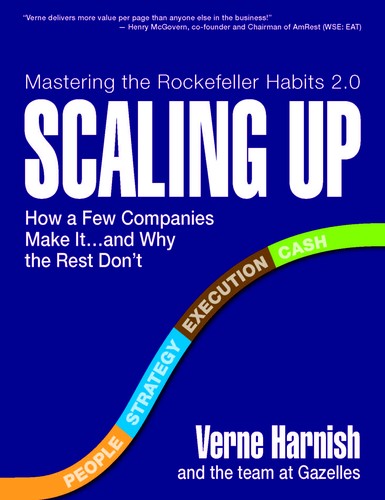
Harnish's framework (an evolution of his earlier Rockefeller Habits work) organises the challenge of scaling around four decisions: People, Strategy, Execution and Cash. It's tool-heavy — one-page plans, meeting rhythms, hiring scorecards — aimed squarely at owners who want a practical system rather than more theory.
Four decisions, and the three things that actually cap growth
Harnish's framework, an expansion of his earlier Rockefeller Habits work, refuses to treat scaling as one problem with one fix. It is four disciplines running at once: People — the right people doing the right things with clear accountabilities; Strategy — something genuinely differentiated that can drive sustained revenue growth; Execution — the rhythms that turn a plan into what happens on a Tuesday; and Cash — enough oxygen to survive the growth itself. Get any one badly wrong and it caps how far the other three can carry the business, however well each is individually run.
Underneath the four decisions sits a blunter diagnosis, and it is the part owners recognise fastest. Harnish argues that scaling firms hit three predictable barriers, and only three. Leadership: not enough people capable of delegating and predicting, so everything routes back through the founder. Scalable infrastructure: systems and premises that worked at ten people and quietly break at forty. And marketing: the inability to attract enough of the right customers and staff to feed growth at the new size. Almost every specific crisis a growing business experiences is one of those three wearing a costume.
He is also candid about the personal cost, which most operating-system books skip. The gap between a business that runs on the owner's memory and one that runs on documented process is crossed by giving up control of things you are good at, to people who will do them differently and initially worse. Harnish's whole toolkit is an attempt to make that transfer survivable — to replace the founder's instincts with something a team can follow without the founder in the room.
Strategy: one page, and the seven layers underneath it
The One-Page Strategic Plan is the tool the book is best known for, and it exists because of a simple observation: a plan too long to remember will not survive contact with a busy week. Everything goes on a single sheet — core values, purpose, the ten-to-twenty-five-year Big Hairy Audacious Goal, three-to-five-year targets, the annual plan, the current quarter's priorities, and the individual priorities that ladder up to them. The compression is the discipline. If the strategy cannot fit, it is not a strategy, it is a wish list.
The deeper strategic content sits in what Harnish calls the 7 Strata: the layers you have to get right for the one page to be worth anything. What words do you own in the customer's mind? Which sandbox are you playing in — the specific customer, need and geography you have chosen? What is your brand promise, and can you attach a guarantee to it that would hurt if you broke it? Can you state the strategy in one phrase, the way Southwest could say it flew people cheaply and Google could say it searched? What differentiating activities support it? What is your X-factor — the ten-times underlying advantage a competitor cannot easily copy? And what single economic denominator are you optimising: profit per what?
That last question is the most useful hour in the book for a small firm. Profit per what — per employee, per job, per van, per covered hour, per client — forces a decision about what the business fundamentally is. Two firms in the same trade optimising profit per job and profit per client will make opposite decisions about almost everything, and both can be right. Not choosing means neither.
Execution: the Rockefeller Habits and the meeting rhythm
Harnish is explicit that execution, not strategy, is where scaling businesses actually die, and his answer is a cadence. The daily huddle runs five to fifteen minutes standing up, with a fixed structure: what is going well, the one number everyone is watching, and — the part that earns the meeting — where anyone is stuck. Weekly is longer and goes deep on a single issue rather than skimming ten. Monthly is for developing managers. Quarterly and annual are for resetting priorities and the theme that dramatises them. Each has a different job, and running one in place of another is the most common way firms convince themselves they have a rhythm when they have a habit of talking.
The logic behind the daily huddle is worth stating plainly, because owners resist it hardest. A stuck project surfaces within twenty-four hours instead of at the month-end review. The cost of fixing most business problems compounds quietly with time, and a fifteen-minute daily meeting that catches one problem a fortnight has already paid for itself several times over. Harnish's rule that the huddle happens whether or not the boss is present is what makes it a system rather than a check-in.
The accountability side is equally mechanical. His Function Accountability Chart puts one name — a single name, not a committee — against every function in the business, with the two or three numbers that person owns. The Process Accountability Chart does the same for the handful of processes that actually move money across the business. Between them they expose the two conditions that quietly strangle growth: functions with nobody accountable, and functions where the accountable person is the founder for the fourth time on the same chart.
People: the decision most owners get wrong slowest
The People chapter is where Harnish is least original and most worth heeding, because he is essentially importing Brad Smart's Topgrading work and the test it produces. Look at everyone in the business and ask whether, knowing what you now know, you would enthusiastically hire this person again for this role. Not tolerate. Not keep. Enthusiastically hire. The reason the question works is that it strips out the sunk cost, the awkwardness and the length of service, all of which are the reasons the wrong person is still there. Harnish's data point is unglamorous but true: the cost of a bad hire in a small firm is measured in the customers and colleagues they quietly cost you, not in their salary.
He ties hiring and firing directly to core values, and is unusually strict about it. Values are not a poster; they are the criteria you screen for in interviews and the grounds on which you let a high performer go. A salesperson hitting target while trampling the values does more damage than one missing target, because everyone else is watching what actually gets rewarded. He also insists that every person should know the one or two numbers they personally own — the mirror of the accountability charts, seen from the individual's side. The test of whether that has landed is simple: stop anyone in the business and ask what their number is this quarter. If they cannot answer, the system is decorative.
Cash: the discipline growth quietly threatens
This is where Scaling Up genuinely earns its place beside its rivals, because it treats cash as its own decision rather than an outcome of the other three. Harnish's foundational point is that growth consumes cash: more stock, more staff paid before customers pay you, longer gaps between spending and collecting. A business can be growing, profitable on paper and simultaneously running out of money — and the faster it grows, the wider the gap gets. Profit is an opinion formed at the year end; cash is what is there on the 28th when payroll runs.
The tool is the cash conversion cycle, borrowed from work by Neil Churchill and John Mullins: how many days elapse between money going out of the business and coming back in, broken into the sales cycle, production or delivery time, and the billing and collection stretch at the end. Each of those is separately shortenable, and most owners have never looked at them separately at all. The related tool, the Power of One, tests seven levers one at a time — price, volume, cost of goods, overheads, debtor days, stock days and creditor days — by asking what a 1% improvement, or one day, would do to cash. The answer is usually startling, and it usually points at price.
Key lessons
- Scaling successfully comes down to four decision areas: People, Strategy, Execution and Cash — get any one badly wrong and it caps growth.
- A one-page strategic plan keeps the whole business aligned on priorities without a bloated planning document nobody reads.
- Weekly and daily meeting rhythms catch small issues before they become quarterly crises.
- Cash, not just profit, needs its own deliberate management system as a business scales — growth consumes cash fast.
Scaling isn't one problem — it's four separate disciplines (people, strategy, execution, cash) that all need deliberate systems, not just more hustle.
What this means for a UK small business
The Power of One is the exercise to run first, because it takes twenty minutes and the numbers are brutal. Take a firm turning over £600,000 with a 12% net margin — £72,000 of profit. A 1% price rise, if you lose no customers, is £6,000 straight to the bottom line, an 8% profit increase from a change most clients would not notice. Cutting debtor days from 45 to 38 on that turnover frees roughly £11,500 of cash permanently. Neither requires a single new customer, and most owners have spent the year chasing new customers instead.
The cash conversion cycle matters more here than the American examples suggest, because of the VAT quarter. A UK firm growing fast collects VAT on rising sales and spends it on wages and stock before the quarter lands, then finds the bill has grown with the business. Add PAYE on the 22nd and it is entirely possible to be profitable, growing and unable to pay HMRC in the same month. A rolling 13-week cash forecast, updated every Friday, catches that months before a bank statement would.
The rest of the framework is heavier than a small firm needs in one go. Take the daily huddle and one accountability chart, run them properly for a quarter, and leave the other tools on the shelf until those two are habits.
What’s aged well
The four-decision framework and tools remain widely used and referenced in the small-business operating-system space.
What feels outdated
Fairly dense and tool-heavy compared with more narrative business books — better as a reference to dip into than a cover-to-cover read.
Where it falls short
It overlaps substantially with Traction, published three years earlier, and anyone who has already implemented one operating system will find much of this the same ground in different vocabulary. It is also tool-heavy to a fault — a small team handed the full kit will implement none of it, and the book does little to help you sequence what matters first. The examples come largely from Harnish's own coaching network, which is textbook survivorship bias: we hear from the firms that scaled while running his system, not the ones that ran it and stalled. And the sizing is off for most UK readers here; it is written for a business heading from 50 to 500 people, not one heading from 5 to 15.
The Business Stuff verdict
Overlaps meaningfully with Traction, but Scaling Up goes deeper on cash and strategy specifically — useful for businesses already growing fast.
Three things to actually do after reading it
- Draft a genuine one-page strategic plan for the business and see how much doesn't survive being forced onto one page.
- Introduce a weekly team meeting with a fixed, short agenda if you don't already have one.
- Build a simple 13-week cash forecast alongside your growth plan, not instead of it.
If you liked this, read next
Five similar books
- Traction (Gino Wickman)
- Good to Great (Jim Collins)
- Measure What Matters (John Doerr)
- The E-Myth Revisited (Michael Gerber)
- Rocket Fuel (Gino Wickman)
Common questions
Scaling Up or Traction — which should I read?
Read one, not both, and pick by your bottleneck. Traction is simpler, more prescriptive and easier for a small team to implement without help — it is the better first operating system for a firm under about twenty people. Scaling Up is broader and considerably stronger on two things Traction skims: strategy, through the 7 Strata and the profit-per-X question, and cash, through the cash conversion cycle and the Power of One. If your problem is that nobody is accountable and meetings are chaos, read Traction. If your problem is that you are growing and running out of money, read Scaling Up.
How small is too small for Scaling Up?
Below about ten people, the full framework is more machinery than the business can carry, and attempting all four decisions at once usually ends with none of them running. That does not make the book useless at five people — it makes it a book you take two tools from. The daily huddle works at three people. The Power of One works at one person. The profit-per-X question is arguably most valuable early, before the business has accidentally chosen a denominator by drifting. Come back for the rest when hiring past the point where you personally know what everyone did today.
What is the cash conversion cycle and how do I work out mine?
It is the number of days between cash leaving your business and cash coming back. Break it into three: how long from first contact to an order, how long from order to delivering the work, and how long from delivering to being paid. Add them, and subtract the days you take to pay your own suppliers. For a typical UK service firm the answer is somewhere north of sixty days, and the third stretch is usually the worst offender. The value is in the breakdown, not the total — each stage has different fixes, and invoicing on completion rather than monthly often takes a fortnight out on its own.
What actually goes in a daily huddle?
Fifteen minutes maximum, standing up, same time every day, and it runs whether or not the owner is there. Three items: quick good news from each person, so the meeting does not become purely a problem list; the one number the team is watching this quarter, stated aloud; and where anyone is stuck. That third item is the whole point — it surfaces a blockage within a day instead of at the month-end. What does not belong is problem-solving. Note the stuck item, name who will deal with it, and take the discussion offline with the two people who need it.