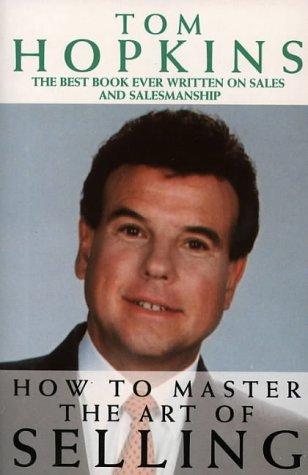
Hopkins, once a top real estate salesperson turned trainer, wrote an exhaustive, practical manual covering the full sales process — prospecting, qualifying, presenting, handling objections and closing — with specific scripts and techniques for each stage, drawn from his own record-setting sales career.
Selling as a trained craft, not a personality
Hopkins' whole book rests on a claim he makes from personal evidence. He failed at selling for six months, spent most of what he had left on a training course, and then went on to a record-setting run in residential real estate before turning to training full time. His conclusion, and the premise of the book, is that selling well is a trained craft with a right technique at every stage, not an inborn charm that some people have and others do not. Everything across four hundred-odd pages follows from that single position.
The structure reflects it. Prospecting, qualifying, presenting, handling objections, closing, referrals — each broken down into named, drillable sub-techniques with the words written out. Hopkins' consistent argument is that improvisation is where otherwise competent salespeople lose deals they had already earned. The moment arrives, they have not decided in advance what they will say, so they hedge, soften, and talk past the point where the buyer was ready.
Rejection with a price tag
The most valuable idea in the book is also the one least associated with it, and it is arithmetic rather than psychology. Hopkins insists that a professional knows their own numbers: how many contacts produce an appointment, how many appointments produce a presentation, how many presentations produce a sale, and what the average sale is worth. Once you have those four figures, every 'no' has a calculable value. If it takes twenty conversations to produce a £1,000 sale, each conversation is worth £50 — whether it ends in a yes or not.
This is a psychological device wearing a spreadsheet as a disguise, and it works on precisely the thing that stops most people selling. Rejection stops being a verdict on you and becomes a cost of goods, with a known price and a known return. It also converts activity into something manageable: if you know your ratios, you no longer need to feel motivated, you need to make the calls, because the maths does the rest. Hopkins pairs it with his rather more motivational creed about never seeing failure as failure, which has aged less well — but the underlying move, taking the emotionally loaded event and turning it into a tracked number, is genuinely how most people learn to prospect without dread.
The words, and the questions
Hopkins devotes serious attention to vocabulary, on the basis that certain words trigger buyer resistance regardless of what is being sold. His replacement list is the famous part: not cost or price but total investment; not down payment but initial investment; not monthly payment but monthly investment; not contract but agreement or paperwork; not sign but approve or authorise; not objection but area of concern; not buy but own; not prospect but future client. Some of that is straightforward euphemism and a modern buyer will see through it. But the observation underneath is sound — at the moment of decision the buyer is scanning for reasons to stall, and words carrying commitment and loss hand them the reasons for free.
The questioning techniques are far more durable, and they are the part of the book still worth drilling. The tie-down attaches a small confirming question to the end of a statement — 'turning up when we say we will matters more than the last five per cent on price, doesn't it?' — inviting agreement in sequence so the close does not arrive cold. He gives the variants: the inverted tie-down at the front of the sentence, the internal one buried mid-sentence, so the technique does not become audible through repetition. The porcupine answers a question with a question: asked 'can you deliver by the fifteenth?', the trained response is 'do you need it by the fifteenth?', because that converts an idle enquiry into a stated requirement you can then meet. The alternate advance offers two options, neither of which is no — Tuesday or Thursday, the standard or the upgraded. All three work as well in a plumber's van as in an estate agency.
He is equally practical about the mechanics around the sale: taking notes in front of the buyer, getting the paperwork out early so it is not a dramatic reveal at the end, and slowing down rather than speeding up at the moment of decision.
Prospecting, qualifying, and the client you already have
Hopkins is more interesting on the front of the process than the end of it, which is the reverse of his reputation. His qualifying discipline is blunt: time spent presenting to somebody who was never going to buy is wasted twice, once on them and once as the opportunity cost of the qualified buyer you did not see that afternoon. The specific wording of his qualifying scripts is dated, but the discipline underneath has aged perfectly — establish before you invest real effort whether the person can decide, can afford it, actually needs it, and has a timescale. Salespeople skip this because asking feels presumptuous, and then spend three weeks on a quote that was never live.
The strongest prospecting material is about the customers you have already sold to. Hopkins' rule is to ask for referrals during the sale, at the point of maximum goodwill, rather than months later in an awkward phone call — and to ask for names and a specific introduction rather than a vague 'do let people know about us'. He also builds the idea of an itch cycle: for any product there is a reasonably predictable interval before the same customer is in the market again, and a professional knows what that interval is for their trade and contacts the customer just before it, rather than waiting to be remembered.
The rest of his prospecting is unglamorous by design — working a defined patch, following up every enquiry, keeping records good enough that nobody falls through. The claim throughout is that a full pipeline is what removes desperation from the room, and desperation is what loses deals and margin.
Objections, closes, and what has aged badly
Hopkins treats objections as a closed set, and this is the reframe most readers find immediately useful. In any given business there are perhaps five or six things buyers actually say. They recur endlessly. A salesperson who has rehearsed a specific response to each performs better under pressure than one improvising — not because the scripted answer is cleverer, but because rehearsal removes the panic, and panic is what makes people either cave on price or start arguing. He is also insistent that an objection is a buying signal. The genuinely uninterested person raises nothing and leaves.
The closing chapters are the book's reputation, for better and worse. Several are still first-rate. The reduction to the ridiculous breaks a price difference down to a per-day figure across the life of the purchase — an extra £600 on a machine that will run for five years is about 30p a working day, which is a fair way of framing a real comparison rather than a trick. The Ben Franklin close builds a written balance sheet of reasons for and against, with the buyer, on the buyer's own terms. The similar situation close answers a concern with a specific comparable customer rather than a reassurance, which is simply evidence properly deployed.
Others have not survived contact with a modern buyer. The sharp angle, the harder assumptive closes, and some of the objection-reversal patterns read as pressure tactics, and today's buyer — particularly in B2B — has very likely read the same techniques and will name them out loud, at which point the sale is over. Used verbatim, parts of this book will lose you business.
What survives all of it is the simplest instruction in the whole volume: ask. Hopkins' most repeated observation is that salespeople routinely do every part of a good sale and then never actually ask for the order, hinting and hoping instead, because the moment of asking is uncomfortable. Forty-odd years on, that has not dated by a day.
Key lessons
- Every stage of a sale — prospecting, qualifying, presenting, closing — benefits from deliberate, rehearsed technique, not improvisation.
- Handling objections is a learnable skill with specific, practisable responses, not something to fear or avoid.
- Asking for the sale directly and confidently, at the right moment, is something many salespeople avoid unnecessarily.
- Rehearsal and repetition of your own material builds the fluency that makes selling feel natural rather than scripted.
Selling is a learnable, rehearsable craft with specific technique at every stage — leaving it to instinct alone usually underperforms deliberate practice.
What this means for a UK small business
The core discipline — rehearse your qualifying questions and your responses to the five objections you actually hear, until they are automatic — is genuinely useful for any UK owner selling without formal sales training, which describes most trades and small professional-service firms. It removes the improvisation panic that causes a good quote to get fumbled in a kitchen or on a call.
The direct-ask principle is the single cheapest thing to lift. British commercial culture leans hard towards the polite hint — 'let me know if you'd like to go ahead' — rather than a clear ask, and it costs work. Test it on your next ten quotes: instead of sending the price and waiting, book the follow-up call when you send it, and on that call ask directly whether they want to proceed. It costs nothing and the difference in conversion is usually visible within a month.
The numbers discipline is the other one worth adopting. Most UK small firms have no idea what a quote is worth on average or how many enquiries it takes to win one, which means every marketing decision is a guess. Two columns in a spreadsheet for a quarter fixes that permanently.
Worked example, with illustrative figures. A plumbing firm wins an average job of £850 at a 40% gross margin, so £340 of margin per job. It quotes 20 jobs a month and wins 5, a 25% conversion rate. That makes every quote worth £85 in margin whether it is won or lost — and each of the 15 refusals worth £85 too, because the 5 wins do not exist without them. That is Hopkins' arithmetic of rejection, and the behaviour it changes is the awkward follow-up call: a task with a known value gets done, a coin toss does not. Lift conversion from 25% to 30% by booking the follow-up when the quote goes out, and the same 20 quotes return 6 wins — £2,040 of margin a month instead of £1,700, on no extra marketing spend.
What’s aged well
The fundamentals of qualifying, objection handling and asking for the sale remain broadly applicable.
What feels outdated
Some of the specific scripts and closing techniques feel dated against the more consultative style buyers now expect.
Where it falls short
Written in 1982 and rooted in 1970s American residential real estate, several of the specific closing scripts read as manipulative by current consultative-selling standards, and a modern B2B buyer will recognise them. Used as written, they damage trust rather than build it — the techniques need extracting from the words they arrive in.
It is also exhausting. The book is long, repetitive, and heavy on capital-letter enthusiasm and Champion-with-a-capital-C motivational framing that grates. The genuinely useful material — the ratios, qualifying, the questioning techniques, rehearsal, and the instruction to ask — could be delivered in a quarter of the pages, and a reader is better off mining it selectively than working through it front to back.
The Business Stuff verdict
A comprehensive classic, best read selectively for technique rather than adopted wholesale in its original scripted form.
Three things to actually do after reading it
- Pick one common objection and rehearse a specific, confident response until it feels natural, not scripted.
- Practise directly asking for the sale at the appropriate moment instead of hinting and hoping.
- Review your qualifying questions and check they filter out poor-fit prospects earlier in the process.
If you liked this, read next
Five similar books
- The Psychology of Selling (Brian Tracy)
- SPIN Selling (Neil Rackham)
- Exactly What to Say (Phil M. Jones)
- Fanatical Prospecting (Jeb Blount)
- To Sell Is Human (Daniel Pink)
Common questions
Is a sales book from 1982 still worth reading?
In parts, and only as a technique manual rather than a philosophy. The durable material has nothing to do with era: knowing your own numbers well enough to put a price on a rejection, qualifying hard before you present, asking questions instead of making statements, rehearsing your own words until they come out fluently, and actually asking for the business at the end. All of that holds in 2026. What has dated badly is the assumption underneath it — a one-call, one-decision-maker sale to a consumer standing in front of you — which describes almost no considered purchase now. Mine it for the drills. Do not work through it front to back expecting a modern sales process.
Are the closing techniques manipulative?
Several of them are by any standard a modern buyer would apply, and pretending otherwise does you no favours. Techniques built on trapping somebody with their own words, or on offering a choice between two options where neither is 'no', were designed for a world in which the buyer could not check you and could not easily leave. A business buyer today can do both, recognises the move when it arrives, and marks you down the moment they spot it. The underlying skills survive the discard: reading whether somebody is ready, asking directly rather than hinting, and having a calm rehearsed answer to the objection you hear every week. Take the structure and say it in your own words.
Which parts should I actually use?
Three, and you can extract them in an afternoon. First, the arithmetic of rejection: work out what a sale is worth to you and how many approaches it takes, and every no acquires a value, which is the most effective cure for call reluctance anyone has found. Second, qualifying — establish early whether this person can decide, can afford it, and has a reason to act now, because most wasted selling time goes on presenting beautifully to somebody who was never going to buy. Third, rehearsal: write your answers to your five most common objections and say them aloud until they stop sounding like a script. Leave the closing chapters until those three are habits.
Should I read this or SPIN Selling?
Read SPIN Selling first if you sell anything considered, expensive, or to more than one decision-maker. Rackham's research-based case is close to the opposite of Hopkins on closing — that in larger sales, closing pressure reduces your success rate rather than raising it, and the real work happens in the questioning long before the ask. Hopkins is stronger at the transactional end: higher-volume, shorter-cycle, one-conversation selling where momentum and a direct request genuinely do decide the outcome. Most UK owner-run firms sit closer to the SPIN end than they assume. Come back to Hopkins afterwards for the discipline and the drills, and read the closing chapters as a historical document.