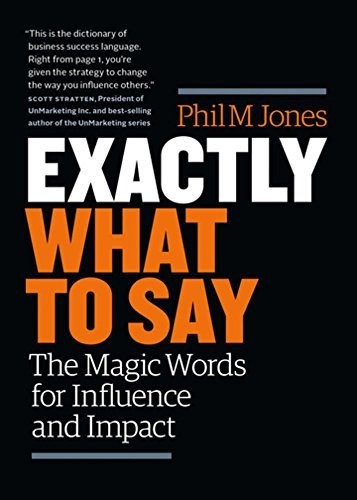
A short, focused book built entirely around 'Magic Words' — specific phrases proven to shift a conversation at a key moment, like handling price objections or moving someone from interest to decision. Deliberately brief and immediately usable rather than theoretical.
Persuasion at the level of the sentence
Jones' premise is narrower, and more testable, than almost any other sales book: this isn't about strategy, relationship-building or diagnosis, it's about the exact words used at one specific moment, on the argument that identical underlying content lands very differently depending on precisely how it is phrased. Ask a customer "do you want to hear about our maintenance plan?" and you have invited a yes-or-no verdict on a proposition they have no context for, from a standing start, with no cost to saying no. Ask "how open-minded would you be about a way to stop this happening again?" and you have started a completely different conversation while saying, in substance, exactly the same thing.
The book is built entirely around what Jones calls Magic Words — short, specific phrases, each with one defined job, each given two or three pages explaining the moment it is for and the mechanism behind why it works. It is barely a hundred small pages and reads in an hour. That brevity is a design decision rather than a shortcut, and it follows from the central claim: these phrases only help if you can actually recall them under pressure, mid-conversation, with a prospect looking at you. A two-hundred-page treatment of each one would defeat the entire purpose.
The phrases that lower resistance
The first group works by reducing a listener's instinctive push-back without changing the substance of what's being said. "I'm not sure it's for you, but..." is the clearest example: it explicitly hands the listener permission to decline before they have heard the idea, which removes the pressure they were bracing against, and — because people want what looks like it might be withheld — tends to increase rather than reduce their interest in hearing the rest of the sentence. It costs nothing and defuses the defensive posture most people adopt the moment they realise they are being sold to.
"The fact that..." is the book's most quietly effective device. It takes the thing the listener has just raised as an objection and reframes it as the reason to act. Too busy to look at a new system? The fact that you're that busy is exactly why this matters. Nothing dishonest has happened — the objection was real and it is being addressed — but the phrasing presents the response as an established consequence rather than as a counter-argument to be debated, and it is remarkable how much less resistance the same content generates.
Jones is also good on negation. Telling someone "don't worry about the price" plants the price as the thing to worry about, because the brain has to process the concept before it can process the instruction to dismiss it. His fix is to say the positive version instead. In the same family sits "I'm guessing you haven't got round to...", which lets a prospect admit they haven't done something without admitting incompetence — you have pre-supplied the excuse, so they can say yes without losing face. That is a small, humane piece of conversational engineering, and it works on the fact that most stalled decisions stall out of embarrassment rather than disagreement.
The phrases that open a door, and the ones that close it
The book's most distinctive single idea is priming with a question before presenting anything: "how open-minded are you about...?" Almost nobody answers "not very", because saying so out loud feels closed-minded, so the listener makes a small verbal commitment to open-mindedness that then colours how they receive whatever comes next. It is a lightweight application of the consistency principle Cialdini documented at length, delivered as a single sentence you can actually remember. "What do you know about...?" does related work at the start of a conversation: it surfaces what the person believes they already know, which lets you correct a wrong assumption by adding to their answer rather than contradicting it.
Others in this group work on imagination rather than argument. "Just imagine..." and "how would you feel if..." ask the listener to run a mental simulation of the outcome, which engages a much less sceptical mode of thinking than evaluating a claim does. "Most people..." smuggles social proof into a sentence without the awkwardness of citing a case study.
At the other end of the conversation, Jones' closing phrases mostly work by narrowing the question. "When would be a good time?" quietly treats the meeting as agreed and negotiates only the timing. "What happens next is..." removes the ambiguity that kills a lot of nearly-done deals, by narrating the process out loud so the buyer isn't left guessing what they're committing to. "If I can, will you?" secures the commitment before the concession is made, which is the difference between a discount that wins the business and a discount that just becomes the new starting point. And "just one more thing..." — the Columbo move — puts the real question in the low-pressure moment after the conversation has apparently ended, which is often when people are most honest.
Two more deserve a mention because they do unusual work. "There are two types of people..." channels a decision by presenting it as a choice of identity rather than a choice of option, and people reliably place themselves in the flattering category. And "before you make your mind up..." buys a hearing at exactly the point a prospect is closing down, by asking for consideration rather than agreement — a much smaller request, and one that's socially awkward to refuse.
For the vague brush-off that has no stated reason behind it — "I don't think it's for us" — Jones' move is simply to ask "what makes you say that?" It sounds too plain to count as a technique, and that is precisely why it works: it converts a closed refusal into information you can actually respond to, and it does so without any of the defensiveness that a counter-argument would trigger.
Rehearsal, not scripting — and the manipulation question
Jones' argument for the whole format is that people fumble the sales-critical moments — the price question, the stall, the hesitant yes — not from lack of understanding but from having to construct the right sentence under pressure in real time. Three or four rehearsed phrases for the situations that recur removes that improvisation tax completely. The book is explicit that these should be practised out loud until they sound like you, not read off a card, because a phrase delivered stiffly does more damage than no phrase at all.
The obvious objection — that this is manipulation — Jones addresses briefly and, to be fair, sensibly: the words change how a message is received, not whether it is true, and if what you're selling doesn't help the person, better phrasing only gets you to a bad sale faster. That answer is right as far as it goes, though the book does rather rush past it. Anyone uncomfortable with the idea should notice that the alternative isn't neutrality — it's whatever phrasing you happen to blurt out, which is also doing persuasive work, just accidentally and usually worse.
One practical note the book makes almost in passing deserves more weight than it gets: these phrases have a half-life within a single conversation. Prime someone with "how open-minded are you" twice in ten minutes and they will notice the technique, at which point every subsequent sentence gets read as a manoeuvre and you are worse off than if you had said nothing clever at all. One or two per conversation, at the moments that actually matter, is the working dose.
Key lessons
- Small, specific phrase choices genuinely change how a listener responds, even when the underlying message is similar.
- 'The fact that...' is one of several small linguistic devices that reduce resistance to a claim you're making.
- Asking 'how open-minded are you...' before presenting an idea primes a more receptive response than presenting it cold.
- Specific, rehearsed phrases for common sticking points (price, timing, decision-making) remove the need to improvise under pressure.
The exact words used at a key moment in a sales conversation matter more than most people assume — having a few rehearsed, proven phrases ready removes a lot of the pressure to improvise well.
What this means for a UK small business
This is the most immediately usable book on the list for a UK owner who dreads one specific recurring moment — the price question, the "let me think about it" stall, the silence on the other end of the phone after a quote goes out. Pick the three moments that cost you the most work, choose a phrase for each, and rehearse them out loud until they sound like something you'd actually say. That is a genuinely low-effort, testable change you can make this week and measure by whether those conversations stop going the same way.
The open-mindedness prime works particularly well in the indirect register of British business conversation, where a direct pitch can feel presumptuous and pushy. Asking permission first — "would it be useful if I...", "how open-minded are you about..." — does real persuasive work while staying comfortably inside UK conversational norms, which is more than can be said for most of the American sales scripts owners here get handed.
"I'm guessing you haven't got round to..." earns its keep in accounting, trades and professional services especially, where clients routinely stall out of embarrassment rather than disagreement — the unsigned engagement letter, the receipts still in a carrier bag, the quote sat unanswered for three weeks. Handing someone a face-saving way to say yes moves more of those than another chasing email ever will.
What’s aged well
The specific phrases remain broadly applicable communication techniques, not tied to any particular era or channel.
What feels outdated
Nothing significant given its recent, focused publication.
Where it falls short
The book is deliberately thin on theory or evidence. Each Magic Word gets an anecdote and an assertion, never a citation, so a reader wanting to know how rigorously any of this has been tested — as opposed to how confidently it is claimed — comes away with nothing. Several phrases are also lifted, unacknowledged, from well-established persuasion research; Cialdini did the actual work behind the consistency and social-proof mechanics here.
It is a toolkit, not a methodology. It won't help with who to sell to, what to sell, or how to build a pipeline — the structural questions that surround the moments it is built for. Used by someone with nothing worth selling, it is just a slicker way to waste a prospect's time.
The Business Stuff verdict
A quick, immediately usable read — less a philosophy of selling than a practical phrasebook worth having to hand.
Three things to actually do after reading it
- Pick three 'Magic Words' phrases from the book and rehearse them for your most common sales sticking points.
- Try priming a pitch with an open-mindedness question before presenting your main idea.
- Prepare a specific, rehearsed response to your most common price objection instead of improvising it.
If you liked this, read next
Five similar books
- Never Split the Difference (Chris Voss)
- Made to Stick (Chip & Dan Heath)
- Influence (Robert Cialdini)
- Sell with a Story (Paul Smith)
- To Sell Is Human (Daniel Pink)
Common questions
Is Exactly What to Say worth reading if I've already read Never Split the Difference?
Yes, because they operate at different levels. Voss teaches a negotiating posture — tactical empathy, calibrated questions, the mindset you bring to a difficult conversation. Jones gives you the actual sentences, ready to use, for about twenty specific moments. Voss is the deeper book and the one to read first if you only read one. Jones is the faster one to apply, and the two do not contradict each other. If you finished Voss thinking the principles were sound but still froze when the price question came, Jones is the follow-up that closes that gap. It takes an hour.
Does using scripted phrases make you sound fake?
It does if you read them off a card, which is why Jones is insistent that you rehearse until they sound like something you would actually say. The phrases are short and conversational for exactly this reason — "what makes you say that?" is not a script, it is a normal question most people simply forget to ask under pressure. The genuine risk is overuse. Deploy two priming questions in the same ten-minute conversation and the other person will notice the pattern, at which point everything you say afterwards reads as technique. One or two per conversation, at the moments that matter, is the working dose.
Which of the phrases should I start with?
Start with the three that map to the moments costing you the most business. For most owners those are: "I'm not sure it's for you, but..." for opening a suggestion without pressure, "what makes you say that?" for the vague brush-off that gives you nothing to work with, and "what happens next is..." for the end of a positive conversation that then goes quiet. That last one alone recovers a surprising number of stalled deals, because the buyer was not hesitating, they simply did not know what they were agreeing to. Write your version of each, say them aloud until they stop sounding rehearsed, then use them.
Is it any use outside sales?
Yes, and arguably more than in formal sales. The phrases are about moving someone from resistance to consideration, which describes most management conversations, supplier negotiations, and any attempt to get a colleague to change how they work. "I'm guessing you haven't got round to..." is as useful chasing a team member for a late report as chasing a client for paperwork, because it does the same job: it hands the person a way to say yes without losing face. What the book will not help with is anything structural — hiring, pricing, strategy. It works on single conversations, one sentence at a time.