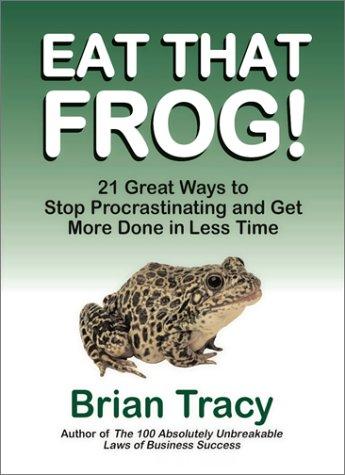
Built around the metaphor of eating your ugliest task first thing (the 'frog'), Tracy offers a short, punchy collection of 21 practical tactics for beating procrastination and tackling the most important, most avoided task before anything else each day.
Eat the ugliest one first
Tracy's central metaphor — if the first thing you do each morning is eat a live frog, nothing worse can happen to you for the rest of the day — is really an argument about two things: energy and momentum. Discipline and clear thinking are at their highest first thing and erode as the day fills with other people's demands, so the task most likely to be avoided, delayed or done badly is exactly the one that should be tackled while that capacity still exists. Save it for "later" and later arrives with the capacity gone. The momentum half matters just as much: finishing something significant before nine gives the rest of the day a different character to one spent aware of a job you're still avoiding.
The refinement is where the rule earns its keep. If you have two frogs, eat the ugliest one first. When several important, unpleasant tasks compete for the first slot, the instinct is to warm up with the second-worst — and Tracy's point is that this is still procrastination, wearing a productive costume, avoidance dressed up as sensible sequencing. The test he applies throughout is consequences: an important task is one with significant long-term consequences, and an unimportant one is anything you could not do without any consequence at all. It's a blunt test, but it separates the genuinely important from the merely urgent better than any feeling of pressure does, and most people's task lists are sorted by pressure.
ABCDE, the Law of Three, and deciding what not to do
Tracy's main sorting tool is the ABCDE method, and it is more useful than its self-help packaging suggests. Every item on tomorrow's list gets a letter. A is something you must do, with serious consequences for not doing it. B is something you should do, with mild consequences. C would be nice to do, with no consequences whatsoever — most people's lists are largely Cs, which is why they feel busy and achieve little. D is delegate: anything someone else could do to a workable standard. E is eliminate entirely. Where multiple As compete, they become A-1, A-2, A-3. The discipline is the rule that follows: you never work on a B while an A is unfinished, and never on a C at all until the rest is genuinely clear. Most people invert this daily, because Cs are pleasant and finishable and As are neither.
Alongside it sits what Tracy calls the Law of Three: across everything you do, a very small number of tasks — his rule of thumb is three — account for the overwhelming majority of the value you contribute. Identify them by asking what would happen to the business if you stopped doing each item on the list, and the three that matter separate themselves quickly. It's the Pareto principle pointed at a to-do list rather than a customer base, and Tracy offers it as a working heuristic rather than a finding, which is the right way to take it.
The corollary is the idea most readers remember: creative procrastination. You cannot do everything, so you will procrastinate on something — the only question is whether you choose what, or let it be decided by whatever happened to be least appealing at the time. Deliberately deciding the low-value activities you are going to neglect, and neglecting them on purpose, is the whole trick. It's the same insight Essentialism and The One Thing would later build entire books around.
Starting, and then not stopping
A good third of the book is about the mechanics of actually beginning, because Tracy's diagnosis is that procrastination is mostly a starting problem rather than a working problem. His fixes are practical and unglamorous. Clear the desk and assemble everything you need before you begin, so the first minute involves no friction and no excuse. Break the intimidating job down: the salami-slice method takes one thin slice and completes it, on the reasoning that once you have started, the pull to continue usually does the rest; the swiss-cheese method puts five or ten minutes into punching a hole in a task you have no appetite for at all.
Then single-handling. Once you start the most important task, work at it without interruption until it is 100 per cent complete — no email, no just-checking, no picking it up and putting it down. Tracy's argument is that returning to an interrupted task carries a real restart cost every single time, so the same total minutes spread across six sittings produce far less than one continuous run. He wraps this in a claim about multiplying your output several times over, which is asserted rather than demonstrated, but the underlying mechanic is sound and has held up well in later work on attention residue.
He also wants the plan made the night before. The daily list gets written the evening prior so the day begins with a decision already taken rather than one to be made under pressure while the day is already happening. A great deal of procrastination, in his account, isn't reluctance to do the task at all — it is the small extra friction of first having to decide what the task even is, at exactly the moment you have least appetite for deciding anything.
Constraints, key skills, and the limits of the format
Two of the twenty-one principles are worth more than the rest and get less attention. The first is identifying your key constraint: in any goal, one factor sets the pace at which everything else can move, and effort spent anywhere else largely evaporates. Tracy's uncomfortable addition is that the binding constraint is far more often internal — a skill you lack, a decision you're avoiding, a conversation you won't have — than the external market conditions people prefer to blame. The second is upgrading your key skills: your weakest important skill sets the ceiling on your results in the same way the narrowest pipe sets the flow, so the highest-return development you can do is the one you are most inclined to avoid, because it is where you are worst.
The rest of the twenty-one range from useful to filler. Several are motivational rather than tactical — develop a sense of urgency, put the pressure on yourself, feed your mind with optimism — and a handful restate the frog rule in different clothing. The book is best read as four or five real ideas with a motivational scaffold around them, and it is short enough that mining it selectively costs almost nothing.
Two of the softer principles are better than their motivational framing suggests. The first is Tracy's long-term perspective point: the strongest predictor of good decisions today is how far ahead the decision-maker is thinking, because the person weighing this year against the next decade chooses differently to the person weighing this afternoon. The second is his instruction to put the pressure on yourself, since almost nobody else will — imagine you have to leave for a month tomorrow and must clear the essentials before you go, which is a surprisingly effective way to work out what the essentials actually were.
He also has a good answer for the task so large it produces paralysis, borrowed from a story about crossing the Sahara by navigating from one oil barrel to the next: you cannot see the destination, so you aim at the next visible marker and repeat. It is the same mechanic as salami-slicing, framed for the goal rather than the task, and it is the honest response to the objection that eating the frog is impossible when the frog is a six-month project.
Key lessons
- Do your most important, most avoided task ('the frog') first thing, before anything else consumes your energy.
- If you have two frogs, eat the ugliest one first — tackle the harder priority, not the easier one, when both matter.
- Plan every day the night before so you start with clarity, not a blank decision to make each morning.
- Apply the 80/20 rule ruthlessly to your daily list — a small number of tasks account for most of the real value.
Procrastination is beaten less by motivation and more by structure — tackling your most important, most avoided task first, before the day has a chance to fill up around it.
What this means for a UK small business
For an owner whose day gets eaten by email, phone calls and whoever shouts loudest, the plan-it-tonight habit alone changes more than it sounds like it should. Deciding tomorrow's frog the evening before means it survives contact with the first urgent WhatsApp of the morning; a decision made at 8am, in the middle of that message arriving, almost never does.
The two-frogs rule earns its keep on precisely the admin most UK owners avoid: the call about the invoice that's ninety days overdue, the VAT return that's been open in a browser tab since Tuesday, the conversation with the employee everyone knows isn't working out. All of them lose, every day, to easier tasks that feel productive. All of them get more expensive with delay — late VAT and late self assessment carry real HMRC penalties and interest, and a debtor at ninety days is materially harder to collect than one at thirty.
ABCDE is worth running over a genuine list once, because the result tends to be startling: most of a small-business owner's week is Cs and Ds — the quote nobody chased, the supplier admin, the social post — while the two As that would actually move the business sit untouched. The letters make that visible in a way another to-do app won't.
What’s aged well
The core tactics are simple and evergreen, still widely referenced in productivity advice.
What feels outdated
Nothing significant; deliberately simple, timeless tactics.
Where it falls short
It's twenty-one short, heavily overlapping tactics rather than one developed argument, so it reads more like a set of motivational chapter headings than a system, and several of the twenty-one are thin restatements of "do the hard thing first" in fresh packaging. Tracy also has a habit of asserting large multipliers — output several times over, hours saved per day — without any source behind them, which is exactly the sort of claim a reader should discount.
Read it in an afternoon for the frog rule, ABCDE, creative procrastination and the evening plan. There genuinely isn't much more underneath, and the books it inspired develop the same ideas further.
The Business Stuff verdict
A quick, practical read — less original than some alternatives on this list, but genuinely easy to start applying today.
Three things to actually do after reading it
- Identify tomorrow's 'frog' tonight, and do it first before checking email or messages.
- Plan the next day's top three priorities the evening before, not first thing in the morning.
- Apply 80/20 thinking to today's task list and cut or delay the bottom 80%.
If you liked this, read next
Five similar books
- The One Thing (Gary Keller & Jay Papasan)
- Essentialism (Greg McKeown)
- Getting Things Done (David Allen)
- Atomic Habits (James Clear)
- Deep Work (Cal Newport)
Common questions
Is Eat That Frog worth reading if I've read Atomic Habits or The One Thing?
Only just. There is heavy overlap, and the other two are better books. The One Thing develops the focus argument further and more convincingly; Atomic Habits explains the mechanics of why behaviour sticks, which Tracy never really attempts. What Eat That Frog has going for it is speed — it is a two-hour read with a metaphor that lodges in your head, and the ABCDE sorting method is a genuinely useful tool the other two do not provide. If you have read both others, read the ABCDE chapter and the one on creative procrastination, and skip the rest without concern.
What is the ABCDE method?
It is Tracy's way of sorting a task list by consequence rather than by urgency or by how appealing each item feels. Every task on tomorrow's list gets a letter. A means serious consequences if it does not get done. B means mild consequences. C means no consequences at all — pleasant, finishable, and the category most people's lists are secretly full of. D means delegate to someone who can do it acceptably. E means eliminate it entirely. Multiple As become A-1, A-2, A-3. The rule that makes it work is the strict one: never touch a B while an A is unfinished, and never a C until everything above it is genuinely clear.
Does eating the frog work if you're not a morning person?
The principle survives; the timing does not have to. Tracy's real argument is that your capacity for hard, unpleasant, cognitively demanding work is finite and gets spent as the day fills with other people's demands — so the difficult task should go where your capacity is highest, not where the clock says morning. If you genuinely peak at 2pm, put the frog at 2pm and defend that block the way a morning person defends 8am. What does not survive is the version where the frog moves to whenever you happen to feel ready, because that reliably means never. Pick a slot, and make it the same slot every day.
Is the book just repackaged common sense?
Largely, and Tracy would not entirely disagree — he is explicit that none of the twenty-one principles are new, and that the gap is between knowing and doing. The honest assessment is that four or five ideas here are genuinely worth having (the frog rule, ABCDE, creative procrastination, single-handling, and the constraint principle) and the remaining sixteen are motivational restatement. That is a reasonable return for two hours, provided you go in expecting a toolkit rather than a system. Where it falls down is that knowing the advice was never most people's problem, and the book offers very little on why we avoid what we know we should do.