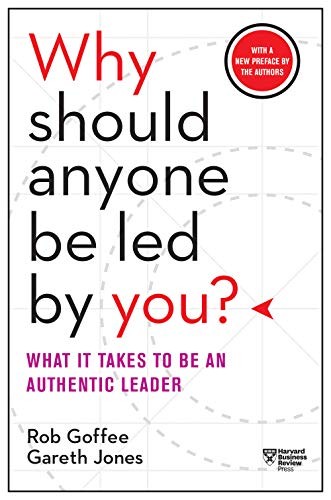
Goffee and Jones push back on the idea of a single ideal leadership style, arguing instead that authentic leadership comes from knowing and deploying your genuine self — including selectively showing weakness, reading situations accurately, and managing 'social distance' from your team deliberately.
The question in the title is the whole argument
Goffee and Jones began with a provocation they put to executives on leadership programmes: why should anyone be led by you? The answers were reliably terrible — job titles, hierarchy, years of experience, a list of competencies copied off a framework. The question has no generic answer, and that is the point. It reframes leadership from something you possess into something other people grant you, which they can withdraw, and which they extend to specific individuals for specific reasons rather than to whoever happens to hold the role.
From that follows their rejection of most of the leadership genre. The idea that effective leadership can be reduced to a checklist of traits transferable from one person to any other does not survive contact with their evidence: across decades of work with senior executives, the leaders people actually chose to follow were highly individual, often awkward, sometimes difficult, and succeeded precisely by being distinctively themselves rather than by executing someone else's template. Copying a leader you admire is, on this account, close to the worst available strategy, because the thing that made them followable was that it was theirs.
There is a structural reason this matters more now than it did when the book was written. Authority that comes with the job title works when people cannot easily leave and cannot easily see alternatives. In a small firm competing for skilled staff, in professional services, in anything where the good people have options, the gap between the compliance a title can compel and the discretionary effort only followership produces is the whole difference between an adequate team and a good one. Goffee and Jones's question is really about that gap.
The book grew out of a Harvard Business Review article and retains that structure — a strong central claim developed through executive interviews and cases rather than through a step-by-step model. Readers expecting a framework will be frustrated, and the authors would say that frustration is the correct response to a genre that has oversold frameworks for forty years.
'Be yourself — more — with skill'
This is the line the book is remembered for, and each part of it is doing work. 'Be yourself' rules out impersonation. 'More' means the qualities that make you distinctive need amplifying deliberately, not merely possessing quietly — a genuinely funny leader who is never funny at work has hidden the very thing people would have followed. 'With skill' is the part that stops the whole thing collapsing into an excuse for self-indulgence: authenticity here is not licence to say whatever you happen to feel, it is the disciplined deployment of the real you in service of a purpose other people share.
Goffee and Jones are explicit that authenticity is achieved rather than found. It requires knowing yourself well enough to identify what your actual differences are — which most people are bad at, and which usually needs feedback from people willing to be honest with you — and then judging which of those differences are assets in this context and which are liabilities. That is ongoing work, not a personality test taken once.
They also make a point that lands harder now than it did in 2006: authenticity has to be consistent across audiences. If the version of you that appears in front of the team is unrecognisable to the version your customers or your family see, it is not a leadership style, it is a performance — and performances are expensive to maintain and eventually visible to everyone.
Selective vulnerability
The book's most counter-intuitive claim is that leaders who deliberately reveal a genuine weakness are trusted more, not less, than those who project unbroken competence. The mechanism is straightforward once stated: visible invulnerability reads as inhuman, nobody quite believes it, and the effort of maintaining it becomes an obvious performance that costs the leader the very trust it was meant to protect. Admitting a real limitation signals that the rest of what you say can be taken at face value.
The skill is entirely in the selectivity. Goffee and Jones distinguish sharply between revealing an incidental weakness — you are disorganised, you are impatient, you are hopeless with names — and revealing one that goes to the core of the job, which is not humility but disqualification. A finance director confessing they find numbers confusing has not built trust. And the choice is contextual: which weakness, to which audience, at which moment. Get it wrong and it reads as either manufactured — the fake weakness of a job interview — or genuinely alarming.
There is a useful secondary effect they note. A leader who names a real weakness creates space for other people to fill it, which is how a genuine team forms rather than a group of people waiting for instructions from someone who claims to need nothing from anyone.
Situation sensing and tough empathy
Where earlier models such as situational leadership prescribe a style for a given readiness level, Goffee and Jones argue for something far less mechanical. Situation sensing is the ongoing, largely intuitive skill of reading what this specific moment, this room and this team actually need — picking up the mood before anyone articulates it, noticing what is not being said, sensing when a decision is being nodded through rather than genuinely agreed — and then responding as yourself rather than from a script.
They are candid that this is much harder to teach than a style matrix, which is part of why they refuse to supply one. Their view is that the genuinely simple models are the ones misleading their readers, and that the honest answer involves developing a perceptual skill over years rather than memorising a grid. The route they suggest is exposure and feedback: put yourself in unfamiliar situations regularly, and find people who will tell you afterwards what you missed.
Alongside it sits tough empathy — caring genuinely about people while giving them what they need rather than what they want. The distinction matters because 'supportive leadership' has drifted towards conflict avoidance, and the authors' position is that a leader who withholds a hard truth to keep things pleasant is not being kind; they are prioritising their own comfort and calling it consideration.
Managing social distance
The practical core of the book is that a leader must be close enough to their team to connect genuinely and gather real information, and far enough away to retain the authority to make unpopular calls and hold people to account. Too close, and difficult decisions become personally costly and get quietly avoided. Too distant, and you lose the trust and the honest information that made good decisions possible in the first place.
Crucially, they frame the right distance as a position that is constantly renegotiated rather than a setting you choose once. It differs by person, by situation and by stage: the distance that worked with a colleague when you were both doing the work is not the distance that works once you are deciding their pay. Leaders who never adjust it — in either direction — get into trouble for opposite but equally predictable reasons.
Underneath all of it is their argument about difference and conformity. Organisations exert relentless pressure towards sameness, and the leaders worth following are the ones who retain and deploy their differences rather than sanding them off to fit in. That is easier said than done, and the book is honest that it carries real career risk inside a conformist organisation — which is, in the end, its most useful warning as well as its central idea.
Key lessons
- Effective leadership is highly situational and personal — there's no single template that works for every leader in every context.
- Selectively revealing genuine weakness, rather than projecting constant strength, builds more trust, not less.
- Leaders need to sense and adapt to context ('situation sensing') rather than applying the same approach everywhere.
- Managing the right social distance from your team — close enough to connect, far enough to maintain authority — is a deliberate skill.
Authentic leadership isn't about adopting a famous leader's style — it's about understanding your genuine strengths and using them deliberately, including your vulnerabilities.
What this means for a UK small business
The social-distance idea lands hardest in small UK teams, where the owner is often genuinely friends with the first few employees. The very closeness that built the business makes the difficult conversation — a pay freeze, a role change, a redundancy — feel like a personal betrayal rather than a business decision, precisely because the distance was never consciously managed. Deciding deliberately how close to be with each person, and adjusting it as both the business and the relationship change, beats letting it drift and then having to overcorrect brutally when something goes wrong.
Selective vulnerability is worth trying directly this week. An owner who says 'I got the cash-flow forecast wrong last quarter, and here is what I am changing' tends to earn more trust from a team of eight than one who never concedes anything — because the team already knew, and the silence was the only thing in question.
And tough empathy has a specific UK edge, which is about to sharpen. Unfair dismissal protection currently begins at two years' service; under the Employment Rights Act it drops to six months from 1 January 2027. The honest conversation in week six — the one where you tell someone plainly that it is not working and exactly what would have to change — is therefore worth far more here than it would be in a hire-and-fire jurisdiction. Avoiding it is not kindness, it is deferred cost.
What’s aged well
The authenticity argument anticipated a broader shift in leadership thinking away from a single 'ideal' leader archetype.
What feels outdated
Some examples are dated, and the writing is more academic than most books on this list.
Where it falls short
By design this is the least prescriptive book in the leadership category. It deliberately refuses to hand over a framework, which is intellectually honest and leaves a reader wanting concrete next steps with far less to act on than almost anything else here. 'Be authentically yourself, but strategically, and read the room better' is genuinely hard to operationalise without a coach or a mentor to calibrate against — something the book effectively concedes.
The evidence base is also almost entirely large-organisation executives, drawn from an era before remote and hybrid working, and it shows: the social-distance chapter quietly assumes a physical office and corridor conversations. The examples have dated, and a small-business owner will have to do the translation themselves.
The Business Stuff verdict
A thoughtful, if less immediately practical, counterpoint to formulaic leadership advice.
Three things to actually do after reading it
- Identify one leadership trait you've been copying from someone else that doesn't actually fit how you naturally operate.
- Consider one situation where showing a genuine limitation, rather than hiding it, would build more trust with your team.
- Assess whether you're currently too close to, or too distant from, your team, and adjust deliberately.
If you liked this, read next
Five similar books
- Primal Leadership (Goleman, Boyatzis & McKee)
- Start with Why (Simon Sinek)
- Dare to Lead (Brené Brown)
- The 7 Habits of Highly Effective People (Stephen Covey)
- Multipliers (Liz Wiseman)
Common questions
So what is the actual answer to the question in the title?
There isn't a general one, and that is the argument rather than a dodge. Goffee and Jones's position is that leadership is granted by followers, for specific reasons, to specific people — so the answer is personal, and it changes with context. What they do offer is a method for finding yours: work out what genuinely makes you different, get honest feedback because most people misjudge this badly, decide which of those differences are assets in this setting, and then deploy them deliberately rather than sanding them off to fit in. Their summary — be yourself, more, with skill — is the whole book in five words.
Isn't 'show weakness' risky advice?
It is, which is why the selectivity matters more than the disclosure. The authors distinguish sharply between an incidental weakness — you are disorganised, impatient, hopeless with names — and one that goes to the core of the job, which is not humility but disqualification. A finance director admitting they find numbers confusing has not built trust. The mechanism only works because the weakness is real, minor and freely chosen: it signals that the rest of what you say can be taken at face value. Manufacture one and it reads exactly like the fake weakness in a job interview, which is worse than saying nothing at all.
How do I judge the right social distance with my own team?
By the decision you are avoiding. Say you run a team of eight and two of them were friends before they were staff. If you find yourself softening feedback for those two, delaying a conversation about performance, or discovering that other people notice they are treated differently, you are too close and the business is already paying for it. If nobody tells you when something has gone wrong until it is expensive, you are too far. Goffee and Jones treat the right distance as constantly renegotiated rather than fixed — the distance that worked when you were doing the work together is not the one that works when you set their pay.
What should I read alongside it?
Pair it with something prescriptive, because on its own it will leave you thoughtful and short of next steps. Kim Scott's Radical Candor gives you the mechanics for the hard conversations this book says you must have, and Patrick Lencioni's The Five Dysfunctions of a Team covers the group-level version of the trust argument. Goffee and Jones's own follow-up, Why Should Anyone Work Here?, applies the same lens to the organisation rather than the individual and is worth reading if you are trying to work out why good people leave. Read this one for the diagnosis and those for the instructions.