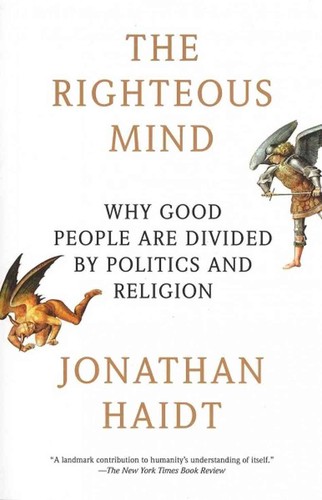
Haidt argues that moral judgements are driven primarily by fast, intuitive reactions, with reasoning constructed afterwards to justify them — 'the emotional tail wags the rational dog'. He maps different moral foundations that vary across people and groups, explaining why genuine disagreements are so hard to resolve through argument alone.
Intuitions come first, strategic reasoning second
Haidt's first big claim is that we have the moral mind backwards. We imagine that we weigh evidence, reason our way to a conclusion, and then feel appropriately about it. His research says the sequence is almost exactly reversed: a fast, automatic, emotional reaction arrives first, and conscious reasoning shows up afterwards to build a respectable-looking case for the verdict already reached. His phrase for it is that the emotional tail wags the rational dog.
The metaphor he builds the book on is a rider on an elephant. The rider is conscious reasoning — articulate, planning, convinced it is in charge. The elephant is everything automatic underneath: intuition, gut reaction, emotion, the accumulated weight of upbringing and temperament. The rider can advise the elephant and can occasionally steer it, but if the elephant wants to go somewhere, the rider's main job turns out to be explaining afterwards why that was the right direction. Haidt's sharpest version of this is that the rider is not the president; it is the press secretary.
The evidence he leans on hardest is moral dumbfounding. Give people scenarios engineered to trigger disgust while removing every actual harm — a family who eat their dog after it is killed by a car, adult siblings who sleep together once, safely and secretly, and feel fine about it — and something revealing happens. People instantly declare it wrong. Then they reach for reasons. Then, one by one, the reasons get closed off by the details of the scenario. And the striking finding is that they almost never change the verdict. They say some version of: I can't explain why, I just know it's wrong. The judgement was never resting on the reasons in the first place.
Once you have seen that, a lot of ordinary experience makes more sense. It explains why winning an argument on the facts so often changes nothing, why people who are demonstrably wrong about a detail simply relocate to a different justification, and why the most persuasive people tend to work on the elephant — through liking, trust, framing and story — rather than firing better evidence at the rider.
There is more to morality than harm and fairness
The second section is Haidt's best-known contribution: moral foundations theory. He argues that human moral judgement runs on a small number of evolved foundations, and that people and cultures weight them very differently. Care versus harm. Fairness versus cheating. Loyalty versus betrayal. Authority versus subversion. Sanctity versus degradation. Later work adds liberty versus oppression.
His analogy is a tongue with several taste receptors. A cuisine that uses only two of them isn't wrong, but it will find food built around the other four baffling or repellent. Haidt's argument — developed from surveys across cultures and political groups — is that Western educated liberal morality draws heavily on care and fairness and treats the other foundations as, at best, irrelevant and, at worst, evidence of bad character. More conservative and more traditional moralities across the world draw on all of them roughly evenly. That is why some disagreements are so intractable: the two sides are not reasoning from shared premises to different conclusions, they are running on different moral hardware and each finds the other's concerns literally unintelligible.
Sitting underneath this is his critique of his own field. Psychology has historically built universal claims about human nature out of samples that are Western, Educated, Industrialised, Rich and Democratic — the acronym WEIRD, which Haidt helped popularise. That population is a statistical outlier on exactly the dimensions that matter here. Moral intuitions many Western readers treat as self-evident turn out to be culturally local, and the parts of morality concerned with loyalty, hierarchy and sanctity carry real weight for the large majority of humanity.
We are Glauconian: reputation beats virtue
Sitting between the two halves is a claim that should unsettle anyone who manages people. Haidt reaches back to Plato's Republic, where Glaucon argues — against Socrates — that people are good only because of what being seen as good gets them, and that anyone handed a ring of invisibility would behave appallingly within a week. Socrates disagrees. Haidt thinks Glaucon was right, and says so plainly: we are Glauconian creatures, far more concerned with how our behaviour looks than with whether it is actually right.
That isn't cynicism for its own sake — it has a design implication. If reputation is the real driver, then the way to get good behaviour out of a group is not to lecture it about values but to build systems where behaviour is visible and reputational consequences are real. Transparency does more work than exhortation. It also explains why the reasoning module is so good at justification: in a species where being seen as fair matters more than being fair, an in-house press secretary who can always produce a defensible account is an extremely useful thing to have evolved.
Morality binds and blinds
The final third is the most speculative and the most interesting. Haidt argues that human beings are, in his formulation, ninety per cent chimp and ten per cent bee: overwhelmingly self-interested and competitive, but with a genuine, evolved capacity to switch temporarily into a mode where individual interest dissolves into a group. He calls it the hive switch, and points at the things that reliably flip it — synchronised movement, ritual, shared music, collective effort, common threat, sometimes psychedelics or awe.
This is where he makes his contested case for group-level selection: that human groups capable of genuine cohesion outcompeted groups that weren't, and that our moral psychology is partly built for team play rather than purely for individual advantage. From that follows his reading of religion — not primarily as a set of factual claims to be assessed and found wanting, but as a technology for binding groups together and enforcing cooperation, which is why it keeps reappearing in every society regardless of what the New Atheists think of its truth claims.
The sting is in the second verb. Morality binds and blinds. The exact machinery that makes a team, a congregation, a political movement or a company genuinely cohesive is also what makes it certain of its own righteousness and incapable of hearing the other side. You do not get the cohesion without the blindness; they are the same mechanism running.
Why any of this is useful outside politics
Haidt writes mostly about American political division, and the final chapter's prescriptions are the weakest part of the book. But the underlying model is a general-purpose tool for any disagreement that isn't really about facts. Once you accept that the other side's conclusion arrived first and the arguments came second, the whole approach changes: you stop trying to win on evidence and start trying to work out which foundation is actually being triggered, and address that.
It also explains why people who agree on every fact can still be miles apart. Take a concrete case: two directors deadlocked over a long-serving employee whose output has slipped, on a £34,000 salary against roughly £22,000 of billable work. They are looking at the same figures. One is weighting fairness and sees a £12,000 hole that everyone else is covering. The other is weighting loyalty and sees the person who worked unpaid through a bad winter. Rerunning the spreadsheet a third time will move neither of them, because the disagreement was never about the £12,000 — and until someone names the two foundations out loud, the meeting just repeats.
Haidt's practical advice follows directly from the rider-and-elephant model, and it is the most portable thing in the book: if you want to change someone's mind, talk to their elephant first. That means warmth, genuine listening, finding something in their position you can honestly agree with, and establishing that you are not a threat — because a defensive elephant leans away and no argument reaches the rider at all. Only once the elephant has leaned slightly towards you does evidence stand a chance. Most people do the reverse: open with the strongest counter-argument, watch the other side dig in, and conclude they are unreasonable.
His closing framing is that opposing moral outlooks work like yin and yang — each reliably sees something the other is blind to, and a functioning organisation, like a functioning society, needs both the person pushing for change and the person asking what will break. That is a comfortable conclusion, and it is where the book is at its most op-ed. But the underlying model earns it: if disagreement is built into the moral hardware rather than being a failure of one side's reasoning, then expecting to argue it away was always the mistake.
Key lessons
- Moral judgements are typically fast and intuitive first, with rational justification constructed afterwards, not the other way round.
- Facts and logic rarely change someone's mind on a values-based disagreement — the intuition came first and the reasoning follows it.
- Different people and groups weight moral foundations (care, fairness, loyalty, authority, sanctity) very differently, which is a major source of talking-past-each-other conflict.
- Genuine persuasion on values-driven topics usually requires addressing the underlying intuition, not just presenting better arguments.
You rarely change someone's mind on something values-based with facts and logic alone, because their conclusion came from intuition first — understanding the underlying moral foundation is what actually opens a real conversation.
What this means for a UK small business
The most useful application isn't political — it's any genuine disagreement with a business partner, a difficult client, or a long-standing member of staff where the facts alone aren't landing. Haidt's model says presenting a better argument rarely works, because the conclusion came from intuition first. What moves the conversation is identifying which foundation is actually in play — fairness, loyalty, authority, care — and speaking to that. A co-director digging in over a pay decision may not be arguing about affordability at all; they may be defending loyalty to someone who stayed through a bad year.
For owners managing a mixed team, the foundations framework is also a practical lens on why one management style lands unevenly. Some staff respond well to clear hierarchy and defined authority; others need to feel a decision is fair and that they were consulted. Neither is wrong, and a single style applied uniformly will alienate roughly half the room.
It is also a useful check on yourself. Anywhere you find a business decision you feel unusually strongly about — a competitor's pricing, a supplier who let you down, someone who left badly — Haidt's model suggests the feeling arrived first and the reasons were assembled behind it. Worth pressure-testing before you act.
What’s aged well
The moral foundations research remains widely cited and influential in psychology and political science.
What feels outdated
Dense and academic in style; a slower read than most books on this list.
Where it falls short
This is a dense academic text in moral psychology with essentially no business application stated anywhere in it — every practical use has to be inferred and translated by the reader, which is real work. It's also heavily American and heavily political in its examples, so UK readers spend chapters on US party dynamics to reach a general point.
Substantively, the group-selection argument in the final third is genuinely contested among evolutionary biologists rather than settled science, and critics have pushed back on how neatly the foundations map onto political tribes. Some of the supporting social psychology also predates the replication reckoning that has hit adjacent research since 2012, so treat individual studies more cautiously than Haidt's confident framing invites.
The Business Stuff verdict
Genuinely important for understanding real disagreement, though not a quick or purely practical business read.
Three things to actually do after reading it
- In your next disagreement, identify the underlying moral foundation driving the other side's position before arguing facts.
- Notice one belief of your own that you arrived at intuitively, then reverse-engineer the reasoning you built to justify it.
- Reframe an argument you're losing around the other person's values, not just your own logic.
If you liked this, read next
Five similar books
- Thinking, Fast and Slow (Daniel Kahneman)
- Never Split the Difference (Chris Voss)
- Influence (Robert Cialdini)
- Predictably Irrational (Dan Ariely)
- Nudge (Thaler & Sunstein)
Common questions
Is this a business book?
No. It is a serious work of moral psychology written mainly about American political division, and it contains essentially no direct business application anywhere in it. Everything useful has to be inferred and translated by you, which is genuine effort. What makes it worth that effort is that the underlying model — intuition first, reasoning second — explains a category of workplace disagreement that no business book handles well: the argument where both sides have the same facts and neither will move. If you want tactics for a negotiation next week, read Never Split the Difference. If you want to understand why some disputes never resolve, read this.
What are the moral foundations?
Haidt identifies care versus harm, fairness versus cheating, loyalty versus betrayal, authority versus subversion, and sanctity versus degradation, with liberty versus oppression added in later work. His argument is that these are evolved intuitive concerns that all humans have, but which individuals and cultures weight very differently — his analogy is a tongue with several taste receptors, where a cuisine built on two of them finds food built on the other four baffling. The practical use is diagnostic: when someone's objection makes no sense to you, it is often because they are weighting a foundation you barely register, and answering them on yours will never land.
Is the science still holding up?
Partly, and you should read it with that in mind. The core claim that moral intuition precedes reasoning is well supported and broadly accepted. The moral foundations framework remains widely used but is genuinely contested — critics dispute how cleanly the foundations separate and how neatly they map onto political groupings. The group-selection argument in the final third is the most contested of all, and is a live disagreement among evolutionary biologists rather than a settled finding. The book also predates the replication reckoning that has hit a good deal of social psychology since 2012, so treat individual supporting studies with more caution than Haidt's confident tone invites.
How do I actually use this in an argument?
Talk to the elephant before the rider. Haidt's model says that leading with your strongest counter-argument makes the other person defensive, and a defensive elephant leans away so hard that no evidence reaches the reasoning behind it. The sequence that works is warmth first, genuine listening second, finding something in their position you can honestly agree with third — and only then introducing the thing you want them to consider. It feels slow and slightly insincere to anyone who prefers arguing on the merits. It is also, on his evidence, the only order that moves anyone on a values-based disagreement.