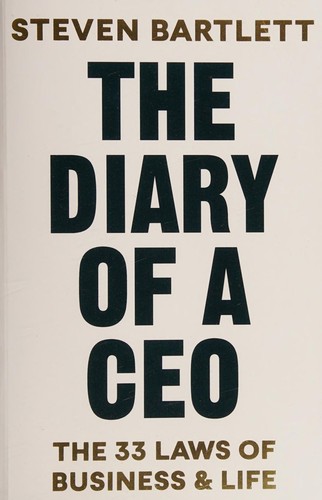
Drawing on lessons from his own entrepreneurial career and his interviews on the Diary of a CEO podcast, Bartlett presents 33 'laws' spanning self-belief, focus, storytelling and leadership, aimed squarely at a newer generation of founders raised on social media and podcasts rather than traditional business school.
Four pillars, thirty-three laws
Bartlett's credentials are the reason the book sells and worth stating plainly: he dropped out of university in Manchester, built the social media agency Social Chain in his early twenties, took it to a public listing and exit, then built The Diary of a CEO into one of Europe's biggest business podcasts and became the youngest investor on Dragons' Den. The book draws on both — his own operating experience and several hundred long-form interviews with founders, scientists and psychologists.
It's structured as 33 short laws across four pillars: The Self, The Story, The Philosophy and The Team. That structure is doing real work. It's not a single-thesis book and doesn't pretend to be; it's closer to a well-organised highlight reel, each law running a few pages built around a study, an interview moment or an episode from Bartlett's own career. The organising conviction, to the extent there is one, is that the soft material — identity, self-belief, story, culture — is load-bearing business infrastructure rather than decoration around the real skills of finance and operations.
What separates it from most books in this register is that Bartlett actually cites things. The laws lean on named behavioural science rather than assertion, and there are references. Whether the underlying research is as solid as the confident summaries suggest is a separate question — but the intent to ground the advice in something is genuine, and it makes the book noticeably more substantial than the podcast-host memoirs it sits next to on the shelf.
Fill your five buckets in the right order
The first law is the best thing in the book and the one most worth acting on. Bartlett argues that everything you have to trade in a career sits in five buckets, filled in a specific order: knowledge (what you know), skills (what you can do), network (who you know), resources (what you have, mostly money) and reputation (what people say about you).
The argument is that the first two fill the last three, and that almost everyone gets the order wrong. Young people optimise for the resources bucket — take the higher-paying job, take the money now — when knowledge and skills are the only two buckets nobody can take from you and the only two that reliably generate the others. Network follows from having something worth knowing you for. Reputation follows from having done things well. Money follows all of it. The practical decision rule it produces is unusually clean: early on, take the role that fills buckets one and two even at a lower salary, and be sceptical of anything that fills bucket four at the expense of them.
He pairs this with a run of laws about identity and self-belief that are more familiar but sit sensibly here — that the ceiling on most people's ambition is set by what they privately believe they're permitted to attempt, long before it's set by market size or competition, and that the stories you tell yourself about past failure are a real constraint rather than a motivational abstraction. It's the standard territory, delivered without much of the usual mysticism, which is about as good as this genre gets.
The story pillar: behavioural science pointed at marketing
The strongest and most distinctive section applies psychology to how businesses communicate, and it's where Bartlett's actual expertise — marketing — shows.
The core argument is that a brand nobody dislikes is a brand nobody remembers. Safe, inoffensive, corporate messaging becomes wallpaper: technically present, entirely unnoticed. Being willing to take a position that some portion of the market rejects is the price of being memorable to the portion that doesn't, and most founders default to the smooth, forgettable version out of habit rather than strategy.
He builds on this with a series of well-chosen effects. The observation that effort creates attachment — people value things more when they've had to work for them — which argues against removing every last piece of friction from a customer experience, because some friction is what makes the outcome feel earned. The peak-end rule, that people judge an experience by its most intense moment and its ending rather than its average, which has an obvious and mostly ignored implication for how businesses end a project, a meal or a customer relationship. And a steady insistence on specificity over generality: a concrete, slightly uncomfortable truth about what you do outperforms a polished abstraction every time, because abstractions are unfalsifiable and therefore unmemorable.
Running underneath is the consistency argument — that showing up repeatedly in public compounds in a way that's easy to dismiss in year one and impossible to ignore in year five. Bartlett is straightforwardly honest that the podcast's commercial success came from years of unglamorous weekly output before any of it paid, not from a viral moment, and he's better than most on how boring the actual mechanism is.
The team pillar, and what the book is for
The final section deals with culture, and it's the most conventional part — psychological safety as the precondition for a team that tells you the truth, hiring for values over credentials, and the argument that culture is what happens when the founder isn't in the room, so it has to be built deliberately rather than assumed. Bartlett draws on the widely cited research finding that how safe people feel speaking up predicts team performance better than the raw talent on the team, which is well-trodden ground but sits naturally alongside the earlier material on self-story and candour.
The honest summary is that this is a synthesis, and a good one. Most of the 33 laws are compressed versions of ideas available at greater length elsewhere — the consistency material overlaps heavily with Atomic Habits, the focus material with Essentialism, the specificity material with a shelf of marketing books. What Bartlett adds is packaging, pace and a modern frame of reference, aimed squarely at readers who are building in public, on platforms, and who would not pick up a 400-page management text.
Judged as an on-ramp — the first business book for someone in their twenties who's absorbed their business education from podcasts — it's genuinely well made and considerably better sourced than its competition. Judged as new thinking for anyone who's already read twenty books in the field, it will feel like a well-organised recap with one excellent original framework in the first chapter.
The philosophy pillar: small things, hard questions
The third pillar is the one that gets least attention and contains a couple of the more useful laws. The first is an argument about standards: the quality of the small, apparently trivial things a business does — the typo in the email, the state of the van, the two-day silence before a reply — is read by customers as a signal about the things they can't see. It's not a new observation, but Bartlett makes the sharper version of it, which is that the small things are the only evidence most customers ever get, so treating them as beneath your attention is a strategic error rather than a stylistic one.
The second is about persuasion, and it's the law most people find counter-intuitive: ask rather than tell. Bartlett's case is that people rarely change their mind because they were argued into it, but frequently change it when a question leads them to reach the conclusion themselves — which makes questioning a commercial skill rather than a conversational courtesy. It's also, not coincidentally, the skill his podcast is built on, and the section reads like someone explaining a craft they've practised several hundred times rather than a principle they've read about.
Around these sit laws about failure and experimentation — the argument that the cost of a failed attempt is almost always lower than it feels and the cost of the attempt never made is almost always higher, so the rational move is more shots rather than better-planned ones. It's the standard case for iteration, told well and briefly, and it's the register the whole pillar operates in: familiar ideas, competently compressed, with enough of a mechanism attached that you could act on them.
Key lessons
- Self-belief and identity, addressed directly and early, are treated as a genuine prerequisite for sustained entrepreneurial effort.
- Consistency in public-facing content and personal brand compounds in ways that are easy to underestimate early on.
- Storytelling and specificity, not generic corporate messaging, are presented as core modern business skills.
- Focus on a narrow set of priorities, echoed from many other authors on this list, is reinforced here for a newer audience.
Much of the timeless business advice found across this list — focus, consistency, storytelling, self-belief — is repackaged here specifically for founders building in public in a social-media-first world.
What this means for a UK small business
For UK founders newer to business books this works as an entry point rather than a source of new information, and there's no shame in that — most of the 33 laws are compressed versions of ideas found at greater length elsewhere on this list. The value is the packaging: short, punchy, actionable before Monday morning rather than after a 300-page commitment.
The five buckets law is the one to actually use, and it applies as much to a business as a career. Ask which bucket your next decision fills: the contract that pays well but teaches you nothing is a resources decision; the smaller job with a client who'll stretch you fills knowledge and skills and eventually fills the others. Plenty of UK small firms spend a decade filling bucket four and wonder why nothing compounds.
The wallpaper argument earns its keep too. Swap 'we provide digital marketing solutions for SMEs' for the actual, specific, slightly uncomfortable story of why you started and who you're genuinely brilliant for. That's an afternoon's work with real reach, given how many UK buyers now research the founder before the service.
What’s aged well
Too recent to fully assess; grounded in ideas that are individually well-established even if the packaging is new.
What feels outdated
Nothing significant given recent publication; the format is deliberately current.
Where it falls short
This is synthesis, not original research. Nearly every law traces back to a named podcast guest or another well-known book, and while Bartlett doesn't hide it, anyone who's worked through even a handful of the classics on this list will recognise most of it. The citations are more decorative than rigorous in places — several of the psychology effects are summarised with more confidence than the underlying literature supports.
The podcast format also shows: some laws are better stories than strategies, memorable in the moment but thin on how to execute them inside a business with real constraints, staff and cashflow. It's an on-ramp, not a manual.
The Business Stuff verdict
An accessible, well-produced synthesis rather than groundbreaking original research — a good on-ramp for a newer generation of readers new to business books generally.
Three things to actually do after reading it
- Pick three of the 33 laws most relevant to your current stage and apply them directly this month.
- Audit your own consistency in showing up publicly for your business, if that's part of your growth strategy.
- Write down one specific story you could tell about your business instead of a generic description.
If you liked this, read next
Five similar books
- Atomic Habits (James Clear)
- Start with Why (Simon Sinek)
- Company of One (Paul Jarvis)
- Grit (Angela Duckworth)
- Purple Cow (Seth Godin)
Common questions
Is it worth reading if you have already read a lot of business books?
Probably not, and that is not really a criticism. The 33 laws are drawn from Bartlett's podcast guests and from the standard canon — the habits material, the focus material, the storytelling material — so a reader who has already worked through the well-known titles will spend most of the book recognising things. Where it earns its place is as a first business book, or as one to hand to someone in their twenties who reads podcasts rather than hardbacks. The packaging is genuinely good, the chapters are short, and the tone assumes no prior reading. Judge it as an on-ramp and it is a strong one.
What are the five buckets?
They are Bartlett's model for what you accumulate in a career, and the order matters: knowledge, skills, network, resources, reputation. His argument is that they fill in sequence — knowledge becomes skill through practice, skill attracts a network, the network brings resources, and reputation is the output of the other four rather than something you build directly. The practical use is diagnostic. If you are early and chasing money, you are trying to fill bucket four before buckets one and two hold anything, which is why the money does not stick. It is not an original idea, but it is a clear one, and it is the part of the book readers quote back most often.
Does the BBC investigation into his podcast affect the book?
It is about the podcast, not the book, but it is a fair reason for caution. In 2024 the BBC World Service reviewed 15 health-focused episodes of The Diary of a CEO and reported that they contained, on average, 14 harmful claims each — statements experts said ran against substantial scientific evidence, largely unchallenged in the interview. Bartlett's production company, Flight Studio, responded that the show offers guests freedom of expression and that progress comes from hearing a range of voices. The business book is not health content and none of that appears in it. What it does justify is scepticism about the scientific studies cited in passing throughout, several of which are summarised more confidently than the research supports.
How long does it take to read?
A few evenings. The laws are self-contained and short, most run to a handful of pages, and the design is built for reading in fragments rather than in long sittings — which makes it one of the easier business books to finish and one of the easier ones to forget. If you want anything to stick, the sensible approach is to ignore thirty of the laws and pick three that describe a problem you actually have this quarter, then write down what you will do differently because of them. Read cover to cover in a weekend, it tends to leave a general feeling of motivation and very little else.