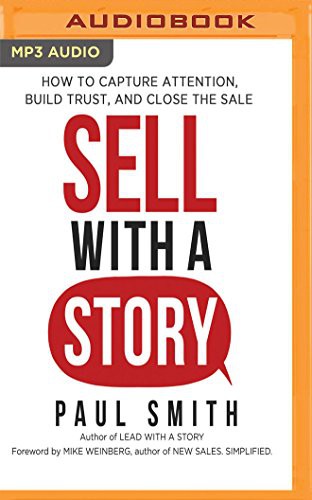
Smith argues that a well-told, specific story persuades far more effectively than a features list, because stories are what people actually remember and repeat internally when making a decision. The book gives a practical structure for building and telling sales stories for different moments in the sales process.
Why a story survives the meeting you're not in
Smith's starting argument is commercial rather than sentimental. People do not remember feature lists. They remember stories. And — this is the part that matters for anyone selling anything with a considered purchase — when the person you pitched to later explains the decision to somebody who wasn't in the room, a partner, a finance director, a co-owner, they retell what they can remember. That is the story, not the spec sheet.
Most B2B and high-value B2C decisions get relitigated by someone who never met you. Your carefully constructed twelve-point case is reduced, in that second conversation, to whatever survived in one person's memory overnight. A well-told story survives that compression more or less intact, because narrative is the format human memory is built for. A dozen bullet points of benefits do not survive it at all — they come out as 'they seemed alright, bit expensive.'
Smith's second claim is about how stories work on a listener. A features list invites evaluation: the prospect sits back and starts judging, comparing, hunting for the catch. A story invites something closer to simulation — the listener imagines themselves in it, and imagining an outcome is measurably more persuasive than being told about one. It also lowers defences. Nobody feels sold to during a story, which is why the technique works on people who have been trained to resist salespeople.
A different story for every moment in the sale
The organising structure of the book is that different points in a sales conversation call for genuinely different stories, and this is where most people who already 'use stories' are going wrong. They have one decent client-success anecdote and they deploy it everywhere, which blunts it and makes it obvious.
Smith maps stories to specific jobs. There are stories that establish who you are and why you're in the room, told early, before anyone's guard is down enough to hear a pitch — including the personal ones about why you do this work and the company's founding story. There are stories that build genuine rapport, which is not the same as small talk. There are stories that explain value in a way a demo or a data sheet can't, by showing the problem before the product. There are stories built specifically to defuse a recurring objection, so that instead of arguing with the prospect you tell them about a previous customer who had exactly that worry and what happened next. There are stories for negotiation and for price. And there are closing stories that let the buyer vicariously experience the outcome before committing to it.
The practical implication is that you need a small library, not one story. Smith is good on the mechanics of building it: keep a running file, capture stories when they happen rather than trying to remember them under pressure in a meeting, and write them down properly — an undocumented story degrades into a vague claim within a month.
Two of those deserve singling out because they are the ones small businesses under-use. The first is the 'why I do this' story — the honest account of how you ended up in this trade, told in thirty seconds. It answers a question every buyer has and almost none will ask, and it is the cheapest differentiator available to a business whose services look identical to three competitors on a comparison page. The second is the founding story: how the product or the firm came to exist, and what problem annoyed someone enough to start it. Where features are commoditised, origin is the one thing a competitor cannot copy.
Specificity is the entire mechanism
Smith is emphatic on this and he is right: vague stories persuade nobody. 'We helped a client save money' is not a story, it's a claim wearing a story's coat. The details are not decoration — they are the thing that makes it feel true rather than assembled for the pitch.
Consider the difference in a real pitch. Version one: 'We've helped lots of manufacturers reduce waste.' Version two, illustrative but built the way Smith wants: a twelve-person joinery firm in Rochdale, where the owner reckoned his offcut waste was 'about normal', measured it for four weeks, found it was closer to a fifth of every board, changed how sheets were nested and cut it to under eight per cent — paying for the whole project inside nine weeks. The second version has a place, a size, a starting belief, a measurement, a specific change and a payback period. It is roughly the same length. It does an entirely different amount of work.
That level of detail also forces honesty, which is a hidden benefit. You cannot tell that story unless it happened, which quietly rules out the inflated generic claims most sales decks are built on. Smith pushes readers to mine their own customer history for the numbers — the actual before-and-after — rather than relying on a warm recollection in the moment.
A structure robust enough to survive an average teller
The last third is craft. Smith gives a spine that any competent adult can follow: a hook that earns you the thirty seconds, context establishing who and where and when, the challenge or problem, the conflict or complication that makes it interesting, the resolution, and then — crucially — the point, made explicitly rather than left hanging.
The deliberate low bar is the book's real value. Smith is not trying to make you a great storyteller; he is trying to make sure the mediocre storyteller still lands the point, because the persuasive power lives in the specificity and the structure rather than in performance flair. He is also good on the failure modes: making yourself the hero rather than the customer, telling it too long, burying the point, over-polishing until it sounds rehearsed, and using a story that flatters you rather than one that addresses the doubt actually in the room. The relatable hero should be someone the buyer recognises as themselves.
Two craft points are worth stealing even if you read nothing else. Use dialogue instead of summary: 'the finance director said he'd been burned by a supplier like us before' lands harder than 'the client had concerns about reliability', because dialogue puts the listener in the room rather than in a report. And be willing to tell a story where you come off badly — the job that went wrong, the estimate you got wrong, what you changed afterwards. Smith's point is that a story admitting a failure buys more credibility than three triumphs, because it is the only kind of story a salesperson has no incentive to invent.
There is a practical discipline attached: write your stories out, time them, and practise them aloud. A ninety-second story that runs to four minutes in the room stops being persuasive and starts being an ordeal. And note the distinction Smith keeps insisting on — an example is not a story. 'One of our clients in Leeds does it this way' is an example. It becomes a story only when it has a person, a moment where something was at stake, and a change between the beginning and the end.
Key lessons
- A specific, well-told story is more persuasive and more memorable than a list of features and benefits.
- Different moments in a sales conversation call for different types of story — building trust, addressing an objection, explaining value.
- Stories work because they let the prospect experience the outcome vicariously, rather than just being told about it.
- A good sales story needs genuine specificity and detail — vague, generic stories don't land the same way.
People remember and repeat stories, not feature lists — a well-chosen story at the right moment in a sales conversation often does more persuasive work than any spec sheet.
What this means for a UK small business
Most UK service firms already have exactly the raw material this book asks for — real client outcomes — sitting unused because nobody ever wrote them down as proper stories. The exercise worth doing this week: pick your three best client results, and for each write a 90-second story with a specific situation, a specific number, and a specific before-and-after. Anonymise where you have to ('a twelve-person joinery firm in Lancashire' works fine), but keep the numbers real. Get consent before naming anyone. Those three stories then do duty everywhere — pitches, the website, a proposal, a networking answer to 'so what do you do?'.
It also suits how British buyers tend to decide. Direct claims about how good you are read as boasting here in a way they don't in the US, and tend to get discounted on the spot. A concrete account of what happened to someone recognisably like the buyer does the same persuasive job without triggering that reaction.
One caution worth naming: if you're regulated — financial services, legal, health — a client story is marketing material and the usual rules on fair, clear and not misleading claims apply. Real outcomes only, no implied guarantee of the same result, and check anything comparative before it goes near a website.
What’s aged well
The storytelling-in-sales argument remains a widely applied technique in sales training.
What feels outdated
Nothing significant; storytelling fundamentals don't really date.
Where it falls short
The core idea is genuinely useful and genuinely simple, and it is stretched across a full-length business book. The taxonomy of story types is finely sliced to the point where several categories overlap enough that the distinctions feel like structure for its own sake, and the middle section repeats its central point more often than it needs to. It could be a long article.
It also assumes a sales conversation with room in it. A quick transactional sale, a trade counter, a competitive tender scored on a matrix — none of these have the two or three minutes a good story needs, and Smith doesn't seriously engage with those contexts. The examples are largely American corporate B2B, too.
The Business Stuff verdict
A practical toolkit for building your own sales stories, useful alongside more structural sales methodologies.
Three things to actually do after reading it
- Write down one specific, detailed customer success story you can tell in under two minutes.
- Match a different story to each common objection you hear regularly.
- Replace one feature-heavy section of your pitch with a relevant, specific story.
If you liked this, read next
Five similar books
- Made to Stick (Chip & Dan Heath)
- To Sell Is Human (Daniel Pink)
- Building a StoryBrand (Donald Miller)
- Exactly What to Say (Phil M. Jones)
- SPIN Selling (Neil Rackham)
Common questions
Is this just about telling client success stories?
No, and that assumption is the mistake the book is written against. Success stories are one type among many, and salespeople who rely on a single all-purpose client anecdote blunt it through repetition. Smith maps different stories to different jobs: one that establishes who you are and why you're in the room, told before anyone's guard is down; one that builds genuine rapport; one that explains value where a demo can't; one built to defuse a specific recurring objection; and one for closing. The practical implication is that you need a small library of four or five, each aimed at a particular moment, not one story deployed everywhere.
What actually makes a sales story work?
Specificity, more than delivery. 'We helped a client save money' is a claim wearing a story's coat and persuades nobody. A twelve-person joinery firm whose owner thought his offcut waste was normal, measured it for four weeks, found it was nearer a fifth of every board, changed how sheets were nested and cut it to under eight per cent — that does real work, because the detail is what makes it feel true rather than assembled for the pitch. The same discipline forces honesty, since you cannot tell that story unless it happened. Structure matters too, but detail is the mechanism; a plain teller with real numbers beats a polished one without.
Is it worth reading if I hate selling?
It is arguably aimed at you. Smith's structural spine — hook, context, challenge, conflict, resolution, then the point stated explicitly — is deliberately set at a low bar so that an average teller still lands it, because the persuasive power lives in the specificity and structure rather than performance flair. He is not trying to make you charismatic. For owners who freeze when a conversation turns to price, having three prepared, timed, true stories is far less uncomfortable than improvising a pitch, and it moves the conversation away from claims about yourself and onto what happened to someone else.
Can I use client stories in my marketing without asking?
Not if anyone could identify the client. Naming a customer, or including details specific enough to point at them, means you are handling their information and often their confidential business data, so get written permission before it goes on a website, a proposal or a case study. Anonymising properly — a sector, a rough size, a region, no names — is usually the simpler route and costs the story very little, since the persuasive detail is in the numbers and the sequence rather than the name. In regulated sectors treat any client story as a financial promotion or equivalent and get it checked before publication.