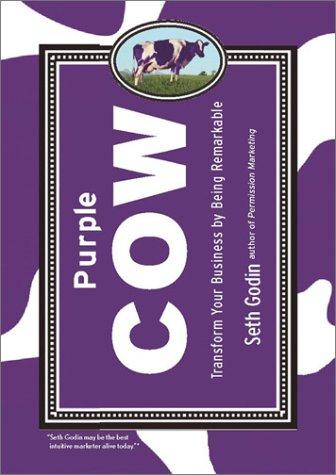
Godin's early, influential argument: in a crowded market, 'safe' and merely good is invisible. A Purple Cow — something genuinely remarkable, worth remarking on — is what actually spreads, because traditional advertising to indifferent audiences has stopped working the way it once did.
Boring is invisible, not safe
Godin's founding claim inverts the instinct most businesses default to. Playing it safe — matching competitors, avoiding risk in the product itself, being reliably good — feels like the responsible option and is in fact the most dangerous one available, because safe and competent is precisely what gets ignored. The image that gives the book its name came from a drive through the French countryside: field after field of cows, beautiful for about five minutes and then completely invisible. A purple one you would stop the car for. Remarkable, in Godin's insistent literal sense, means worth making a remark about. Not excellent. Not high-quality. Worth mentioning to someone else, unprompted, without being paid to.
That distinction does more work than it first appears to. Most businesses, asked what makes them different, produce a list of things that are true, creditable and utterly unremarkable — friendly staff, attention to detail, twenty years of experience. None of those has ever caused a customer to interrupt a conversation to tell a friend about them. Godin's test is brutally simple, and most propositions fail it.
The end of the TV-industrial complex
Godin dates a structural shift rather than a stylistic one. For roughly fifty years, the reliable path was to build an adequate product, buy enough advertising to make people aware of it, use the resulting sales to buy more advertising, and repeat — what he calls the TV-industrial complex. It worked because attention was abundant and cheap: a handful of channels, a captive audience and nowhere else to look.
That machine was already breaking down when he wrote in 2003, and for reasons that had little to do with any particular technology. Consumers had run out of attention and, more importantly, had run out of problems that urgently needed solving. When everyone already owns a perfectly good version of the thing, no amount of interruption makes them want a slightly better one. Godin's conclusion is uncomfortable for anyone whose growth plan is a bigger ad budget: you can no longer buy your way to relevance for an ordinary product. If the advertising has to do all the differentiating, you have already lost. Two decades on, with ad blockers, streaming and skippable everything, the argument reads as understated rather than dated.
The new P sits inside the product, not the campaign
The book's most practically useful move is where it puts remarkability. Godin proposes the Purple Cow as an addition to the traditional marketing Ps, and the point of framing it that way is that it belongs at the product-design table, not in the marketing department afterwards. Marketing, in his formulation, is no longer something you do to a finished product; it is a set of decisions made while the product is still being designed, because those are the only decisions capable of producing something worth talking about.
His examples all share that shape. Dutch Boy's twist-and-pour paint container — light, resealable, with a handle, replacing the metal tin you had to lever open with a screwdriver and then pour badly — sold far better not because of the advertising but because the packaging itself was the news. JetBlue put leather seats and seatback television into a low-fare airline. Krispy Kreme built a window into the shop so you could watch the doughnuts being made. In every case the remarkable element is structural. You could not have added it later with a clever campaign, and it handed customers something concrete to tell people about.
Otaku, sneezers and the edges
Godin's diffusion logic explains why niche-first is not merely a small-budget consolation. He borrows the Japanese word otaku for an obsessive, slightly disproportionate passion for a category — the people who will drive an hour for the right hot sauce, or read four forums before buying a bike. Every category has a group with otaku and a much larger group with none, and the difference matters because remarkable ideas only travel through people who care. He calls the carriers sneezers: they spread ideas because they are genuinely excited, which is precisely why you cannot buy them.
This inverts the standard plan of aiming at the mass market first. The mass market is, by definition, the group with the least interest in your category and the least inclination to talk about it. Godin's route runs the other way — build something remarkable to a small, well-chosen group of obsessives, let the sneezers carry it outward, and let the mainstream arrive later if it arrives at all.
So how do you actually make something remarkable? His answer is to go to the edges. Take any dimension of your category — price, size, speed, service, ease, quantity, formality — describe the two extremes honestly, and then go and live at one of them. The cheapest and the most expensive both get talked about; the third-cheapest never does. The corollary is the bit most people skip: if you are genuinely at an edge, some people will actively dislike what you have done. Criticism is the receipt, not the failure. Something nobody objects to is something nobody noticed.
Why organisations sand the edges off
Godin spends real time on the organisational obstacle, which is the bit most readers underestimate. Remarkable ideas rarely die because someone proves them wrong. They die by committee — softened in a review meeting, focus-grouped towards the average, hedged until they offend nobody and interest nobody. The very process most businesses use to reduce risk is the process that guarantees a brown cow, because compromise moves everything towards the middle and the middle is exactly where invisibility lives.
His counter-example of institutional failure is instructive: the US Postal Service's ZIP+4, a genuinely useful improvement in addressing accuracy that spread barely at all, because the organisation had no way to make it matter to anyone and no story worth repeating. Useful is not the same as remarkable, and an innovation with no champion inside the business dies quietly however sound it is.
The practical consequence is that being remarkable is a management problem as much as a creative one. Someone has to be allowed to make a decision that a committee would have vetoed, and the business has to be able to survive it not working. Godin's argument is that the cost of a failed remarkable attempt is usually smaller and more recoverable than businesses assume, while the cost of the slow, safe, invisible decline is enormous and almost never attributed to the decisions that caused it.
Milk the cow, then build the next one
The last third of the book is about lifecycle, and it is the part most readers forget. A purple cow does not stay purple. Once something remarkable works, it gets copied, absorbed and normalised, and the business that built it settles into defending it — which is the exact moment it turns brown. Godin's discipline is to run two things at once: milk the current cow for every bit of cash it will produce, and spend some of that cash inventing the next one, deliberately, before you need it.
That is a genuinely awkward instruction for a profitable business, because it means funding the disruption of the thing currently paying the bills, and being willing to fail visibly and cheaply along the way. But the argument closes here: if remarkable is a requirement rather than a bonus, then producing remarkable things has to become a repeatable habit, not a one-off stroke of luck you spend the next decade living off.
Key lessons
- Boring, safe products don't get talked about, however competently made — remarkable is what actually spreads.
- Traditional interruption advertising to a mass, indifferent audience is increasingly ineffective and expensive.
- Design the remarkable element into the product itself, not just the marketing wrapped around it.
- Being remarkable to a specific niche who cares beats being merely good to a broad audience who doesn't.
In a crowded market, safe is actually the riskiest strategy — being genuinely remarkable to the right people is what gets talked about and bought.
What this means for a UK small business
The uncomfortable question the book forces is specific and answerable: what does this business do that a customer would tell a friend about unprompted? Not "good service" — every competitor claims it, and nobody has ever mentioned it at a dinner table. A café that is merely pleasant is invisible on a high street with three other pleasant cafés; a café with one odd, talked-about thing — a house rule, a dish nobody else does, a standing arrangement with the school across the road — gets for free the word of mouth the pleasant ones are buying Google Ads to chase.
The go-to-the-edges instruction is the most usable part for a small UK firm, because edges are cheap and budgets are not. A trades business that guarantees a genuine appointment time rather than a four-hour window, a garage that photographs and texts every fault before touching it, an accountant who publishes their prices when nobody else in town will — none of those cost much, all of them sit at an extreme of a dimension customers actually care about, and all of them give people something concrete to repeat.
It is also a useful gut-check before any launch. If the plan is "the same as the competition, done slightly better", Godin's argument is that slightly better rarely earns a mention, however true it happens to be.
What’s aged well
The core argument about differentiation over interruption has only strengthened as advertising has become more crowded since 2003.
What feels outdated
Some of the case studies are dated, though the underlying argument holds up well.
Where it falls short
The book is thin — closer to a long, energetic essay than a developed argument — and it restates its central image far more often than it develops new ones. That makes it a fast, invigorating read and a light one to act on: knowing you should be remarkable is not the same as knowing what remarkable thing to build, and Godin gestures at the how far more than he explains it.
The survivorship bias is real and unacknowledged. For every purple cow he celebrates, businesses bet on something odd, failed, and never made it into a case study; several of his own examples subsequently struggled badly. "Be remarkable" is riskier advice than a pep talk makes it sound, and the book never costs that risk for a firm that cannot afford a failed bet.
The Business Stuff verdict
A quick, energising read that still lands — a good jolt for anyone playing it too safe.
Three things to actually do after reading it
- Identify the one genuinely remarkable thing about your product — if you can't name one, that's the work to do.
- Look at your last three marketing pieces and ask honestly whether they're safe or actually worth remarking on.
- Pick a specific niche audience who would find your remarkable element genuinely exciting, and speak directly to them.
If you liked this, read next
Five similar books
- This Is Marketing (Seth Godin)
- Positioning (Al Ries & Jack Trout)
- Contagious (Jonah Berger)
- Made to Stick (Chip & Dan Heath)
- The Pumpkin Plan (Mike Michalowicz)
Common questions
What is the single most useful idea for a small business owner?
Go to the edges — pick one dimension customers care about, live at an extreme of it, and do the arithmetic before you commit. Illustratively: a two-van heating firm replaces its four-hour appointment window with a guaranteed one-hour slot. That means holding back roughly an hour of slack per engineer per day. At a fully loaded £220 a day over eight hours, the slack costs about £27.50 per engineer per day, or around £1,100 a month across two vans. It needs roughly six extra jobs a month at £180 gross margin to wash its face. That is a real number you can test in a quarter, and running it is exactly the step most businesses skip before deciding they cannot afford to be different.
Isn't 'be remarkable' just a slogan?
On its own, yes — which is why the edges instruction matters more than the cow does. Godin's operational version is specific: list the dimensions of your category (price, speed, size, formality, service, guarantee, range), describe the two extremes of each honestly, and decide which extreme you could actually occupy. The middle of every one of those dimensions is invisible by definition, because it is where everybody already is. That turns an inspirational instruction into a short workshop with a decision at the end of it. The book is thin on running that process, but the process is there, and it is what separates the argument from a motivational poster.
Does a 2003 argument about advertising still hold up?
It holds up better now than when it was written, which is unusual for a marketing book. Godin's claim was that interruption advertising aimed at an indifferent mass audience was becoming uneconomic because attention had run out. Everything since — ad blockers, skippable video, streaming without ad breaks, the collapse of print circulation — has pushed in the same direction. What has changed is the mechanism of spread: his sneezers now have distribution no small business could have imagined in 2003, which makes a genuinely remarkable thing travel further and a merely competent one disappear more completely. The examples date badly and several of the companies he praises later struggled. The underlying argument does not.
What if my business is genuinely boring and heavily regulated?
Then the remarkable thing lives in the service dimensions rather than the product, which is usually easier and cheaper. Accountancy, insurance, waste collection and conveyancing are all constrained products with almost unconstrained delivery: what you publish, how fast you answer, what you guarantee, what you refuse to take on, how you price, and what you say when something goes wrong. A conveyancer who commits to a same-day response on every email is doing something structurally remarkable in a category whose standing complaint is silence. Godin's test still applies — would a customer mention it unprompted? — and in a boring category the bar for clearing it is lower, not higher.