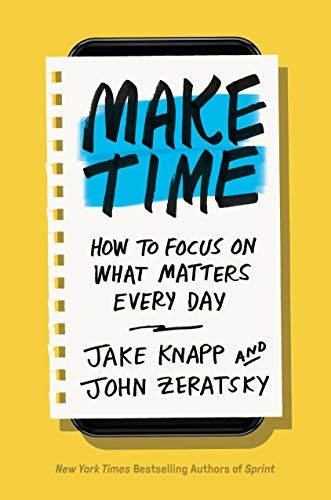
From two former Google Ventures designers, this offers a simple daily framework — pick a 'Highlight' (your priority for the day), find focus by resisting distraction, energise through basic physical habits, and reflect briefly each evening — paired with dozens of specific, optional tactics to try.
Four steps, repeated daily
Knapp and Zeratsky both came out of Google and Google Ventures — Knapp is the man behind the design sprint — and Make Time comes from noticing that most days are not designed at all. They are reactions to whatever showed up first. The fix they propose is deliberately small: four steps, run every day, forever.
Pick a Highlight: one thing that, if it happened, would make today feel well spent. Not a to-do list, not three priorities — one. They suggest sizing it at roughly sixty to ninety minutes, big enough to matter and small enough to actually finish, and choosing it by one of three tests: what is most urgent, what would be most satisfying, or what would bring the most joy. That last one is unusual in a productivity book and is doing real work — a day spent entirely on urgency is how people burn out while ticking every box.
Then Laser: get properly focused on the Highlight by removing what will interrupt it. Then Energize: treat your body as the thing that powers your brain, because a tired body produces a useless afternoon. Then Reflect: three lines in a notebook at the end of the day on what worked, what didn't, and what you'll try tomorrow.
It is worth putting money against why the choice matters, because the Highlight almost never wins on urgency alone. Suppose a small agency owner has two candidates for tomorrow: clear a backlog of 60 emails, or spend 90 minutes on a pricing review they have deferred since spring. The inbox is louder and will be refilled by Thursday. The pricing review, if it moves a day rate from £400 to £450 across roughly 120 billed days a year, is worth £6,000 — and it costs one Highlight. That asymmetry is the entire argument of the book, and it is why the three tests for choosing a Highlight matter more than any of the tactics.
The Reflect step is the one most readers skip and the one that makes the rest function. Without it the book is a pile of tips. With it, it becomes an experiment you run on yourself, where each day's data changes the next day's setup. The authors are explicit that they are not offering a system to comply with — they are offering a loop to iterate.
The two enemies: Busy Bandwagon and Infinite Pools
Two named villains do most of the analytical work, and the naming is the point — it is much easier to resist a thing once it has a label you can spot in the wild.
The Busy Bandwagon is the default culture of packed calendars, overflowing inboxes and permanent reactivity, where being busy is treated as evidence of being valuable. It feels productive and generates almost nothing of consequence, because everything on it was chosen by somebody else. Its defining feature is that you end a fourteen-hour day genuinely unable to name what you achieved.
Infinite Pools are anything with a bottomless, algorithmically refreshed supply: email, social feeds, news, streaming, group chats. The word 'infinite' is doing the work. A newspaper ends. A feed does not, and it is engineered by professionals to never leave you satisfied, only interrupted. Knapp and Zeratsky's point is that these two enemies feed each other — the bandwagon leaves you drained, the drained brain reaches for a pool, and the pool leaves you more drained.
Picking a Highlight before the day starts is the direct countermeasure to both. It gives you something concrete to defend before either the bandwagon or the pools get a vote on your day. If the Highlight happened, the day worked, regardless of what else landed.
Design beats willpower
The strongest idea in the book is that most people try to fight distraction with self-discipline and lose. That is not a character failing. Infinite Pools are built by very large teams of very capable people whose actual job is to beat your willpower, and they are better at their job than you are at resisting. Willpower is the wrong weapon.
The alternative is environment design: make the distraction harder to reach so the fight never has to happen. Their flagship version is the distraction-free phone — deleting email, social apps and browsers from the device entirely rather than trying to use them less. It sounds extreme until you notice you can still reinstall anything in ninety seconds, which is precisely the point: you are not banning it, you are adding enough friction that reaching for it becomes a decision rather than a reflex. Related tactics run the same logic — turn the screen greyscale so it's less rewarding, leave the phone in another room, log out of accounts, set the browser homepage to blank, skip the morning news.
This is the same insight that underpins Atomic Habits — change the environment rather than relying on discipline — but applied to a single day rather than a life. Where Clear is building a system for years, Knapp and Zeratsky are trying to rescue this afternoon.
The tactics under Laser are mostly about pre-committing rather than resisting in the moment. Block the Highlight into the calendar as a real appointment, so the time is defended before anyone else can book it. Put your phone in another room while you do it. Fly without wi-fi. Close the door, or find one to close. Set a visible timer, which works partly because a running clock makes the passage of time honest. And watch for what they call time craters — the small interruption that costs ten seconds and then thirty minutes, because the re-entry into concentrated work is far more expensive than the interruption itself. Anyone who has 'just quickly checked' an email mid-task knows the crater is real even if the name is twee. Put rough numbers on it: an owner who checks email eight times while pricing a job loses perhaps four minutes to the checking and another forty getting back into it, which is why the quote that should take 90 minutes reliably eats an afternoon.
Energy is a productivity variable, not a wellness aside
The Energize section is more substantial than the standard 'sleep well and exercise' paragraph these books usually include, mostly because it is specific about mechanisms. Move every day but stop treating exercise as an all-or-nothing commitment — twenty minutes counts. Eat in a way that doesn't produce a mid-afternoon crash. Get real daylight. Treat caffeine as a drug with timing rules rather than a default beverage: wait a while after waking before the first coffee, stop by early afternoon so it isn't still in your system at bedtime, and use it deliberately before the Highlight rather than continuously all day.
They also make a decent case for treating solitude and screen-free time as energy inputs rather than luxuries, and for protecting sleep as the single highest-leverage change most people could make and won't.
A menu, not a method
Unusually for the genre, the authors refuse to prescribe. The bulk of the book is more than eighty specific tactics grouped under the four steps, and you are told explicitly to try a few, keep what works, and throw the rest away without guilt. Some will be useless to you. Some are borderline silly. The permission to discard is itself the method, and it is why the book survives contact with real life better than more rigid systems: there is nothing to fall off, because there was never a wagon.
That also makes it the right recommendation for someone who has bounced off Getting Things Done or a full productivity methodology. The bar to entry is one decision tomorrow morning, and the whole thing is written in a light, illustrated, dip-in-and-out style that takes an evening to read.
The authors are also unusually honest about their evidence, which is worth noting because so few books in this genre are. They do not claim research backing. They say explicitly that this is what two people worked out by experimenting on themselves for years, that they disagree with each other on several tactics, and that you should expect a decent proportion of what they suggest to be useless to you personally. In a category built on borrowed authority and confident universal claims, that modesty is the most trustworthy thing about the book — and it's the reason the Reflect step isn't optional. Without it you're just following two strangers' preferences. With it, you're running the same experiment they ran, on the only subject whose results matter.
Key lessons
- Choose one 'Highlight' for the day, deliberately, rather than letting the day's priority be decided by whatever's loudest.
- The 'Busy Bandwagon' and 'Infinite Pools' (email, social media, news) are default traps that consume time without you choosing to spend it.
- Basic physical energy management — sleep, movement, food — directly affects your capacity for focused work.
- A short daily reflection helps you notice what's actually working and adjust, rather than repeating the same day indefinitely.
Most days get filled by default — reactive busyness and infinite digital distractions — rather than by deliberate choice; picking one Highlight each day is a simple way to take some of that choice back.
What this means for a UK small business
An owner's day gets hijacked constantly — a supplier ringing about a delivery, a WhatsApp from a client at 8pm, an email that feels urgent and isn't. The Highlight habit is a two-minute fix worth trying before anything more elaborate: decide, before you pick the phone up, what today's one thing is. If it happens, the day worked. For most small firms the Highlight that never gets picked is the one that actually moves the business — the pricing review, the hiring conversation, the quote for the bigger job — because it is never the loudest thing in the inbox.
The Infinite Pools warning deserves taking literally if you run the business's social media yourself. 'Just checking the page' is exactly the trap, and it is worth splitting posting — scheduled, deliberate, ten minutes — from checking, which is open-ended and never finishes. Same for the accounting software dashboard: looking at the bank balance six times a day is not cash-flow management.
Be realistic about fit. If you're behind a counter, on site, or with clients booked all day, the Laser tactics largely don't apply — but the Highlight and the evening Reflect still do, and they're the two that matter most.
What’s aged well
The 'Infinite Pools' framing of endlessly refreshing apps has, if anything, become more relevant since publication.
What feels outdated
Nothing significant; still current.
Where it falls short
The breadth-over-depth format means nothing here is explored as thoroughly as a single-idea book like Deep Work, and a fair number of the tactics are thin — one-line suggestions padding out the count rather than earning their place. There's also heavy overlap with Digital Minimalism, Essentialism and Atomic Habits; if you've read those, a good chunk will feel familiar.
The bigger limitation is audience. It is written by and for knowledge workers with meaningful control over their own calendars, and the evidence base is essentially two men experimenting on themselves rather than any research. An owner answering a shop counter or a site phone all day will find whole chapters simply don't apply.
The Business Stuff verdict
A light, experimental, easy-to-dip-into menu of tactics rather than a rigid system — good for readers who want to try things rather than commit to a full methodology.
Three things to actually do after reading it
- Pick one Highlight for tomorrow, in writing, before the day begins.
- Identify your biggest 'Infinite Pool' distraction and add one small piece of friction to accessing it.
- Try one physical energy tactic (a short walk, earlier sleep) for a week and notice the effect on focus.
If you liked this, read next
Five similar books
- Deep Work (Cal Newport)
- Essentialism (Greg McKeown)
- Digital Minimalism (Cal Newport)
- Atomic Habits (James Clear)
- The One Thing (Gary Keller & Jay Papasan)
Common questions
How is this different from Deep Work or Atomic Habits?
It is far lighter, and deliberately so. Deep Work is one argument about concentration explored in depth; Atomic Habits is a system for building behaviour over years. Make Time is a daily loop plus a large menu of small tactics, aimed at rescuing this afternoon rather than redesigning your life. It shares Atomic Habits' core insight — change the environment rather than relying on willpower — but applies it to a single day. If you have read all three, the overlap is significant and Make Time is the least original. If you have read none, it is the easiest to start with, because the entry cost is one decision tomorrow morning.
Do I have to do all the tactics?
No, and the authors are explicit that you shouldn't try. The book contains more than eighty optional tactics and the instruction is to pick a few, test them, keep what works and discard the rest without guilt. That permission is the actual method rather than a get-out — it is why the book survives contact with real life better than rigid systems, since there is no wagon to fall off. It also means a proportion of what you read will be irrelevant or faintly silly for your situation, which is a feature of the design rather than a defect, though it does make the middle of the book feel thin.
Does it work if I don't control my own diary?
Partially, and it's worth knowing which half applies before you buy. The Laser section assumes meaningful control over your own calendar — blocking time, closing doors, deleting apps — which is written by and for knowledge workers and doesn't survive a shop counter, a van or a fully booked treatment room. The Highlight and Reflect steps survive anything, because they cost two minutes at each end of the day and don't require you to defend a block of time. Pick one thing that would make today count; write two lines at night on whether it happened. That much works for any owner in any trade.
What's a Highlight and how do I pick one?
A Highlight is the single thing that, if it happened, would make today feel well spent — one, not three, and sized at roughly 60 to 90 minutes so it is big enough to matter and small enough to finish. The authors give three tests for choosing it: what is most urgent, what would be most satisfying, or what would bring the most joy. Rotating between those tests matters, because a run of days chosen purely on urgency is how people end up busy, compliant and burnt out. For most small business owners the Highlight that never gets picked — pricing, hiring, the bigger quote — is the one that actually moves things.