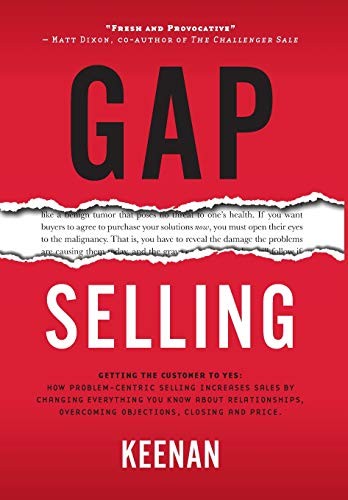
Keenan's framework centres sales around the 'gap' between a customer's current state and their desired future state — the size and clarity of that gap is what actually creates urgency to buy, not clever pitching. Salespeople are pushed to diagnose deeply before prescribing anything, much like a doctor.
Problem-centric, not product-centric
Keenan's central metaphor is medical: a competent doctor doesn't prescribe before diagnosing, but most salespeople are pitching product within minutes of a conversation starting, because that's what they've been trained and incentivised to do. Gap Selling insists on a genuine diagnostic phase — understanding the prospect's current situation in real, specific, quantified detail — before any solution is named, on the basis that a prescription without a diagnosis is guessing with confidence.
The consequence is a stance Keenan calls problem-centric selling, and it is a bigger shift than it first appears. In a product-centric conversation the seller's expertise is in their own product. In a problem-centric one it has to be in the customer's business — how their operation actually works, where it breaks, what a broken version of it costs. That is a considerably higher bar, and Keenan is blunt that most salespeople cannot clear it, which is why they retreat to features: features are the thing they actually know. His fix is unglamorous homework, done before the call rather than during it.
The anatomy of a gap
The framework is deceptively simple. Map the customer's current state. Map their desired future state. The distance between the two is the gap, and the size and clarity of that gap — not your pitch, not your features, not your rapport — is what creates buying urgency. A small or vague gap produces a prospect who is mildly interested, enthusiastic in meetings and never quite gets around to signing. A large, clearly articulated gap produces urgency the seller doesn't have to manufacture.
Where Keenan adds real value is in refusing to let "current state" stay superficial. He breaks it into three layers, and insists you need all three. The physical: the literal, observable facts and numbers — how many, how long, how often, how much. The emotional: how the problem actually makes the buyer feel, because the individual sitting opposite you is a person whose weekends are being ruined by this, not an abstraction called the business. And the root cause: why the problem exists at all. Miss that last layer and you are selling to a symptom, which is how deals get won and then churn, because the thing you fixed wasn't the thing that was wrong.
Then the impact — quantifying what the gap is costing, in money and in time, at both the business level and the personal level. Keenan's point is that a buyer who has said out loud, in their own words, that the current mess costs roughly £4,000 a month and two evenings a week has done work no seller could do for them. The number itself matters less than who said it. A cost the seller asserts is a sales claim; a cost the buyer calculates is a fact they now have to live with.
Discovery is the job
Most of the book's practical weight sits in discovery, and Keenan is uncompromising: this is not a phase to get through en route to the demo, it is the sale. He wants far more questions than most sellers are comfortable asking, of distinct kinds. Probing questions establish the physical facts. Process questions establish how the work actually flows today, which is where the root cause usually hides. And provoking questions — the hardest to do well — challenge an assumption the buyer has stopped examining, the "why do you do it that way?" that reveals a problem the prospect had normalised.
That normalisation is Keenan's sharpest observation. Many buyers genuinely cannot articulate their current state accurately without help. They know something is wrong, but they have never quantified it, or they have lived with it so long it has become simply how things are. The seller's real value-add, in this framework, is often the diagnostic conversation itself — helping the buyer see clearly what the situation is costing them, before either party has mentioned a solution. Done properly, the prospect ends the call knowing something about their own business they didn't know at the start, which is also the most reliable way to earn the right to a second call.
The future state needs the same rigour as the current one, and this is where most sellers get lazy. "Better", "more efficient" and "more visibility" are not future states; they are adjectives. A usable future state is as specific and measurable as the current one — the month-end close done in three days instead of eleven, the two evenings a week back — because you cannot size a gap when one end of it is a mood. Keenan's discipline is to make the buyer articulate both ends in their own numbers before anything else happens.
Only then does the demo make sense, and Keenan's version of it looks nothing like a feature tour. Having diagnosed a specific problem with a specific cost and a specific root cause, you show the two or three things that close that particular gap, and nothing else. Everything shown that doesn't map to a diagnosed problem is noise, dilutes what matters, and hands the buyer more surface area to object to — which is why the exhaustive walkthrough of every feature, still the default in most software sales, actively loses deals it should win.
The status quo is the competitor
Keenan's most useful strategic point is about who you are actually competing against. It is rarely the other vendor on the shortlist. It is doing nothing — the option that requires no budget approval, no implementation, no risk and no one to defend it. "No decision" kills more pipeline than any rival, and it wins precisely when the gap has been left too small or too vague to justify the disruption of change.
This reframes objections completely. Where most sales training treats an objection as a hurdle to be cleared with a rehearsed rebuttal, Keenan treats it as evidence of a diagnostic failure earlier in the process. A prospect who genuinely understands what their current state costs, and genuinely wants the future state, does not push back hard on price — the gap has already done the persuading, and price becomes arithmetic. If you're fighting on price, you didn't establish the gap. Handling the objection better is treating the symptom of your own mistake.
The same logic makes him ruthless about pipeline honesty. Keenan has no time for what he calls happy ears — the deals that feel good, where the prospect was friendly and interested, and which sit in the forecast for two quarters before dying. If you cannot state the prospect's current state, their future state, the quantified impact and the root cause, you do not have a qualified opportunity; you have a nice conversation you enjoyed. Applying that test honestly tends to shrink a pipeline dramatically, which is the point.
It also demands a level of honesty most sales cultures actively punish. If the diagnostic shows the prospect's gap is small, or that your product doesn't close it, Keenan's position is that you say so and walk — partly because the deal was never going to close anyway, and partly because being the person who told a buyer the truth is worth more over a career than one forced sale. That is easy to write and hard to do with a quota to hit, and Keenan doesn't pretend otherwise.
Key lessons
- The size of the gap between current state and future state — not the product's features — is what creates genuine buying urgency.
- Diagnose the customer's actual problem thoroughly before proposing any solution, rather than pitching product first.
- Many buyers don't fully understand their own current state or its true cost until a good salesperson helps them see it clearly.
- Objections are frequently a sign the gap wasn't established clearly enough earlier in the conversation.
Customers buy to close a gap between where they are and where they want to be — establishing that gap clearly matters more than any feature pitch.
What this means for a UK small business
This maps unusually well onto UK B2B selling, where buyers are often culturally reluctant to admit that something is costing them money, and where a direct "what's this costing you?" can land badly if it arrives too early. The three-layer discipline — establish the physical facts first, then the process, then the cost — draws the same information out without it feeling like an interrogation, because you have earned the right to the question by the time you ask it.
It's also a sharp corrective for small firms that quote too fast. Sending a proposal after one call, before the gap is understood, is exactly the pattern that loses winnable work: you end up competing on price against two other quotes for a job nobody has properly defined. For an agency, a trade or a professional services firm, writing the prospect's current state, desired future state and quantified impact on one page before the proposal goes out is a genuinely useful habit regardless of what you think of the rest of the book.
Run the same test over your own pipeline this week. Every open opportunity where you cannot state the gap in the client's own numbers is very probably a no-decision waiting to happen, and knowing that now is better than forecasting it for another quarter.
What’s aged well
The diagnostic, gap-focused approach remains a well-regarded modern addition to consultative selling methodology.
What feels outdated
Nothing significant given its recent publication.
Where it falls short
Keenan's style is combative and frequently self-congratulatory, with a lot of swearing deployed as evidence of straight talking, and a reader who doesn't enjoy being told they're doing everything wrong will find it wearing. The book is also badly in need of an editor — it repeats itself, and the medical metaphor gets stretched well past where it holds, since a doctor has objective diagnostic instruments and a salesperson has a conversation and the buyer's own account.
It is aimed squarely at complex, considered B2B purchases. Running the full diagnostic on a quick transactional sale is disproportionate, and would irritate a buyer who just wants a price.
The Business Stuff verdict
A clear, well-argued framework that complements SPIN Selling's older diagnostic approach with more modern language.
Three things to actually do after reading it
- Before your next pitch, map the prospect's current state and desired future state explicitly.
- Ask two more diagnostic questions than you normally would before proposing a solution.
- Review a recently lost deal for whether the gap was ever made genuinely clear to the buyer.
If you liked this, read next
Five similar books
- SPIN Selling (Neil Rackham)
- The Challenger Sale (Dixon & Adamson)
- Never Split the Difference (Chris Voss)
- To Sell Is Human (Daniel Pink)
- The Psychology of Selling (Brian Tracy)
Common questions
What is the gap in gap selling?
It is the distance between the customer's current state and their desired future state, and Keenan's argument is that the size and clarity of that distance — not your pitch or your features — is what creates urgency to buy. Both ends have to be specific to be usable. "Our reporting is a mess" and "we want better visibility" is not a gap, it is two adjectives. "Month-end close takes eleven days and two people's evenings, and we need it in three" is a gap, because it can be sized. Once a buyer has articulated both ends in their own numbers, the case for change largely makes itself and price becomes arithmetic.
How is Gap Selling different from SPIN Selling?
They are the same family, roughly forty years apart. Rackham's SPIN came out of observational research into thousands of real sales calls and gives you a question sequence — situation, problem, implication, need-payoff — with evidence behind it. Keenan gives you a diagnostic structure instead: current state at three levels, future state, quantified impact, root cause. Keenan's contribution is the insistence on root cause and on the seller having real business acumen, which SPIN treats more lightly. SPIN is the better-evidenced book and the more careful one; Gap Selling is the more modern and the more usable day to day. Reading both is not redundant.
Does it work for small or transactional sales?
Not really, and Keenan would say so himself. Running a full diagnostic on a £200 transactional purchase is disproportionate and will irritate a buyer who just wants a price. The method earns its keep where the purchase is considered, the buyer has alternatives including doing nothing, and the cost of the problem is large enough to be worth quantifying — professional services, software, equipment, anything with an implementation. Below that threshold, take one idea from the book and leave the rest: ask what prompted them to look now. Even in a quick sale, that single question tells you whether there is a real gap or idle curiosity.
What if the prospect won't tell you what the problem is costing them?
Usually they are not withholding it — they have genuinely never worked it out, which is Keenan's central observation about buyers. So do not ask for the number directly. Ask for the components and let them assemble it: how often does this happen, how long does each occurrence take, who is doing that work, what does it stop them doing? For example, a prospect who says the wrong-order problem hits twice a week and costs half a day each time has just told you it costs a day a week, and they will reach that conclusion themselves within a sentence or two. A cost you assert is a sales claim. A cost they calculate is a fact they now have to live with.