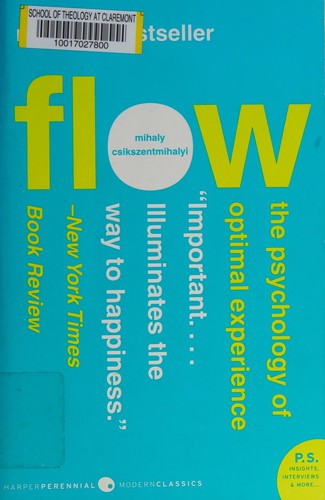
Csikszentmihalyi's foundational research identifies 'flow' — a state of complete absorption in an activity, where challenge and skill are closely matched — as one of the most consistently reported sources of genuine satisfaction, distinct from passive pleasure. The book explores what conditions produce flow and how to design more of it into work and life.
What flow actually is, and how he found it
Csikszentmihalyi (chick-sent-me-high) did not start with a theory. He started with a question that had bothered him since childhood in wartime Europe: why do some people stay engaged and intact under conditions that flatten everyone around them? The answer took decades of interviews with surgeons, rock climbers, chess players, dancers, welders and Alpine farmers, and what came back was strikingly consistent across all of them. People described their best moments in almost identical language regardless of what they were doing, and — crucially — not one of them described lying down.
The method behind the book matters, because it is what separates this from the motivational literature that followed. Csikszentmihalyi's team developed the Experience Sampling Method: give people a pager, buzz them at random points across a week, and have them record on the spot what they were doing and how they felt. It sidesteps the usual problem with asking about happiness, which is that people answer from memory and memory edits. Sampled in the moment, across thousands of reports, a pattern emerged that people's after-the-fact accounts of their own lives systematically got wrong.
The state itself has recognisable components, and he lists them precisely: a task with clear goals; immediate feedback on how it is going; a challenge matched to your skill; concentration deep enough that action and awareness merge; the everyday worries dropping out of the mind entirely; a sense of control over what you are doing; the disappearance of self-consciousness; and a distorted sense of time, which usually contracts and occasionally stretches. Not every component has to be present. But the more of them a task carries, the more reliably it produces the state, and the more likely the person is to describe the experience afterwards as worth doing for its own sake — autotelic, in his coinage, from the Greek for self and goal.
Attention is the scarce resource, and consciousness the thing being ordered
The subtitle of the book is the psychology of optimal experience, but the real subject is control of attention, and this is the part most later readers skip. Csikszentmihalyi's framing is that consciousness has a fixed, quite small processing capacity, and that everything you can ever experience must pass through it. Attention is therefore not a productivity resource. It is the raw material of a life: what you attend to, over decades, is what your life will have consisted of. He is deliberate about this — it is the argument that makes the rest of the book more than a set of tips.
Against flow he sets psychic entropy: the disordered state where attention is pulled in competing directions by anxiety, boredom, resentment or distraction. It is the default condition of an unoccupied mind, which is why he is rude about the idea that leisure is restorative in itself. Left with nothing demanding to attend to, most people do not find peace; they find whatever is worrying them. Flow is the opposite — what he calls negentropy, order in consciousness — and it is achieved not by removing demands but by accepting one demand so completely that nothing else can get a hearing.
This is also where the book's most under-appreciated claim sits: that flow is not a reward for good conditions but a skill that can be practised under bad ones. He devotes a chapter to people who built order in consciousness in genuinely terrible circumstances — prisoners, people with severe disability or long illness, survivors of catastrophe — and argues that the common factor is the ability to set a solvable goal inside the situation you are actually in, rather than waiting for the situation to change.
The channel between boredom and anxiety
The model everyone remembers is the simple graph: challenge on one axis, skill on the other. Where challenge outruns skill you get anxiety. Where skill outruns challenge you get boredom. Flow lives in the narrow diagonal channel where the two are matched and both are reasonably high — not relaxation, but a demand you are only just equal to. It is a useful diagram, and it explains a lot of ordinary experience, including why a job that was absorbing in year one is deadening in year four with nothing having changed except the person doing it.
The important implication is that the channel is unstable by design. Doing something in flow makes you better at it, which lowers the challenge relative to your new skill, which drops you into boredom unless the task gets harder. Csikszentmihalyi treats this as the engine of the whole system: flow is not a comfortable equilibrium you settle into, it is a moving target that drags complexity upward behind it. That is why he thinks flow activities produce growth as a side effect, and why an activity that never gets more demanding cannot keep producing it however enjoyable it once was.
It also explains why some activities are flow machines and others almost never are. Sport, games, music and craft come with the conditions pre-installed: the goal is unambiguous, the feedback is instantaneous, and the difficulty can be dialled up. Much modern work has none of this. The goal is contested, the feedback arrives months later if at all, and the difficulty is set by whoever emails you. His point is that this is a design problem, not a character problem, and design problems can be fixed.
The paradox of work, and the autotelic personality
The single most surprising finding in the book, and the one business readers should sit with, is what the pager studies showed about work. People reported flow far more often at work than in their free time — by a wide margin — and yet, sampled at those same moments, they also reported wishing they were somewhere else. Off duty, with the television on, they reported little flow and considerable apathy, while insisting that this was the part of life they valued. Csikszentmihalyi calls it the paradox of work, and its explanation is cultural: we have inherited a story in which work is the cost and leisure the reward, and the story is strong enough to override what people actually experience.
Two portraits carry the argument. Serafina Vinon, an elderly farmer in the Italian Alps, whose day is objectively gruelling and who, asked what she would do with unlimited money and time, describes the life she already has. And Joe Kramer, a welder in a Chicago railway plant who turned down promotion, learned every machine in the works, and repaired them for the satisfaction of it — a man with an ordinary job and an extraordinary relationship to it. The book's term for what they share is the autotelic personality: the learned capacity to find the goal, the feedback and the challenge inside whatever is in front of you, rather than requiring the situation to supply them.
The closing argument extends this from tasks to a whole life. Individual flow episodes are good but disconnected; what turns them into something coherent is what he calls a life theme — a single organising challenge that gives disparate activities a shared direction, so that the ordering of attention accumulates instead of resetting each week. It is the most philosophical part of the book and the least tidy, but it is the reason Flow is a serious work rather than a technique manual.
Key lessons
- Flow occurs when the challenge of a task closely matches your skill level — too easy produces boredom, too hard produces anxiety.
- Clear goals and immediate feedback within a task are necessary conditions for flow to occur.
- Flow states are consistently reported as more satisfying than passive leisure, despite requiring more effort.
- Work, not just leisure, can reliably produce flow if designed with the right challenge-skill balance and feedback.
Genuine satisfaction comes more reliably from well-designed challenge matched to skill than from passive relaxation — worth deliberately designing into both your own work and your team's.
What this means for a UK small business
The practical translation for an owner is task design, not motivation posters. Most small-firm jobs sit at one end of the channel or the other: mind-numbing repetition, or permanent firefighting with no skill match. A trades apprentice on the same basic job two years past the point of challenge is disengaging for an entirely predictable reason, and the fix is a harder task with a clear standard, not a pep talk or a pay rise.
The feedback point is the sharpest one for UK firms specifically, because our feedback loops are absurdly slow. Work done in March gets reviewed when the accounts land the following January; a hire's real quality shows up two quarters late. Anything that shortens the loop moves people toward the channel — a daily job-complete count on a whiteboard, same-week client responses read out loud, a weekly gross-margin figure per job. Imagine a five-van plumbing firm posting first-time-fix rate every Friday: the number is cheap to collect and it turns an invisible year into a visible week.
And the paradox of work is worth an owner's honest attention. Staff will tell you they want the demanding parts of the job taken away, and the pager data suggests those are the parts producing whatever engagement they have. Stripping challenge out of a role in the name of kindness usually produces a bored, drifting employee who leaves within the year.
What’s aged well
The concept of flow has become foundational across psychology, design and management, and remains widely referenced.
What feels outdated
Denser and more academic in style than most modern popular psychology books, but the core research holds up.
Where it falls short
This is an academic book from 1990 and reads like one — dense, circular in places, and considerably less tightly edited than the popular psychology it inspired. The descriptive research on what flow is and where it occurs is far stronger than the prescriptive material on how to get more of it, so a reader wanting a method will find better instructions in Deep Work or Drive, both of which build directly on this foundation. The evidence is also self-report throughout, with all the softness that implies. And the later chapters on meaning and the life theme drift into philosophy that will lose a business reader entirely. Read the first two-thirds properly and skim the rest without guilt.
The Business Stuff verdict
The foundational text on a genuinely important concept — worth the effort even though it's a harder read than most on this list.
Three things to actually do after reading it
- Identify one task where your current skill level is mismatched to the challenge, and adjust it deliberately.
- Build clearer goals and faster feedback into one piece of recurring work to encourage flow.
- Notice which parts of your week reliably produce flow, and protect more time for them.
If you liked this, read next
Five similar books
- Drive (Daniel Pink)
- Deep Work (Cal Newport)
- The Happiness Advantage (Shawn Achor)
- Grit (Angela Duckworth)
- Mindset (Carol Dweck)
Common questions
What is flow, in plain English?
It is complete absorption in a demanding task: the state where you stop noticing yourself, time behaves oddly, and the activity feels worth doing for its own sake. Csikszentmihalyi's contribution was showing it is not a vague mood but a specific state with identifiable preconditions — a clear goal, immediate feedback, and a challenge matched to your current skill. That matters practically, because conditions can be engineered where moods cannot. If someone on your team never reaches it, the first thing to check is not their attitude but whether their work has a clear goal and any feedback faster than the annual review.
Can you actually create flow at work, or does it just happen?
You can create the conditions, which is most of the job. The three levers are the ones the research keeps identifying: make the goal for a piece of work unambiguous, shorten the feedback loop so people learn within days rather than months, and adjust the difficulty so it sits just above current skill. In practice that means a defined standard for what 'done' looks like, a number the person can see moving, and a deliberate step up in responsibility roughly every time someone gets comfortable. You cannot force the state itself, but a job with none of those three will reliably prevent it.
Is Flow worth reading if I have already read Deep Work?
Deep Work is the more useful book if you want instructions; Flow is the more useful one if you want to understand why the instructions work. Cal Newport builds directly on Csikszentmihalyi's research and says so, but narrows it to knowledge work and concentration. Flow is broader and stranger — it covers factory work, sport, physical craft, solitude and adversity, and its underlying argument about attention as the raw material of a life goes somewhere Deep Work does not. If you found the ideas in Deep Work convincing, the original is worth the extra effort. If you only want tactics, you already have them.
Why does the book say work produces more flow than leisure?
Because that is what the pager data showed. When Csikszentmihalyi's team sampled people at random moments, reports of deep absorption came far more often from working hours than from free time — and yet at those same working moments people said they would rather be elsewhere, while defending their much less absorbing leisure as the good part of life. His explanation is cultural rather than psychological: we inherit a story in which work is cost and leisure is reward, and it is strong enough to override direct experience. Most jobs already contain goals, feedback and challenge; most evenings do not.