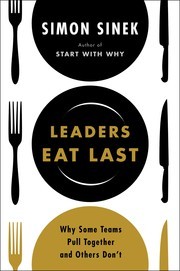
Sinek argues that great leaders create a 'circle of safety' that protects their team from internal and external threats, drawing on biology, military case studies and business examples to explain why some organisations inspire real trust and cooperation, and others quietly breed self-interest and fear.
The circle of safety
Sinek's central image is borrowed from military life: in the US Marine Corps, the most junior eat first and the officers eat last, and nobody has to be told to organise it that way. Rank buys you the right to go hungry a bit longer. Sinek's argument is that this isn't ceremony — it's the visible expression of a bargain that makes the whole institution function. People will run towards danger for a group that has demonstrated it would do the same for them, and they will not do it for a group that hasn't.
Translated into an organisation, the circle of safety is the boundary a leader draws around their people. Outside the circle sit the genuine threats every business faces — competitors, a recession, a client who has gone quiet, a supplier who has let you down. Inside it should sit nothing more dangerous than the work. The problem Sinek identifies is that in a lot of companies the most frightening thing in a person's day isn't the market at all: it's their own manager, the ranking system, the quarterly cull, the colleague competing for the same promotion. When the danger is inside the circle, people spend their energy defending themselves from each other. That energy has to come from somewhere, and it comes out of the work.
The corollary Sinek keeps returning to is that leadership is a choice rather than a rank. Plenty of people hold senior titles and protect nobody; plenty of people with no title at all cover for a struggling colleague, take the blame for a team mistake, or stay late so someone else can get home. Both are leadership decisions, and both are contagious. He opens the book with Captain Mike Drowley, an A-10 pilot who flew down through cloud cover in Afghanistan — effectively blind, at real risk of hitting a mountain — because troops on the ground were under fire. Asked why, Drowley's answer is the whole book in a sentence: they would have done it for him.
The chemistry of trust
The book's most distinctive move — and its most argued-over — is grounding all this in body chemistry. Sinek groups four chemicals into two pairs. Endorphins and dopamine he calls the selfish chemicals: endorphins mask pain so you can keep going, dopamine rewards you for hitting a target, finding food, ticking something off. They evolved to make an individual effective. Serotonin and oxytocin are the selfless ones: serotonin is the pride you feel when someone you respect recognises your work, and the pride they feel in you; oxytocin is the warm, slow-building chemistry of friendship, trust and generosity.
His practical point is that modern management runs almost entirely on dopamine. Targets, dashboards, leaderboards, commission, the ping of a closed deal — all dopamine, all short-term, all measurable, and all, he notes, mildly addictive. Serotonin and oxytocin are harder to measure and therefore neglected, yet they are what actually produce loyalty. Oxytocin in particular is released slowly, through repeated acts of genuine generosity and time spent together, which is why trust cannot be installed at an away-day. It is also, he argues, why a business can hit every number and still be a miserable place that people leave.
Against all four sits cortisol, the stress chemical. Cortisol is designed for short bursts — the noise in the bushes — and it works brilliantly for that. What it is not built for is being switched on permanently by an environment where you might be restructured out at any moment. Sinek's sharpest claim is that chronic cortisol suppresses oxytocin: an anxious organisation doesn't just feel worse, it becomes chemically less capable of the trust that would fix it. Whether or not you accept the neuroscience at the level of confidence he presents it, the organisational observation underneath is hard to argue with — frightened people make worse decisions and cooperate less.
Destructive abundance
The phrase Sinek uses for what happens when the selfish chemicals are allowed to run an organisation unchecked is destructive abundance: plenty of results, plenty of growth, and a steady erosion of the trust that made any of it possible. His historical account traces it to the shift from the 1980s onwards, as management was progressively redefined around shareholder return and quarterly numbers, and the workforce moved from being the point of the enterprise to being a cost line within it. Mass redundancy stopped being a last resort and became a normal quarterly instrument.
His counter-examples are deliberately extreme. Charlie Kim at Next Jump introduced a lifetime employment policy — once you are in, you are not fired for performance; you get coached. Sinek's interest is less in the policy itself than in what it changes about behaviour: when people are not quietly braced for removal, they will admit a mistake early, ask for help, and flag a problem while it is still small. Every one of those is worth money, and every one of them is suppressed by a culture that treats fear as a motivational tool. The argument is that job security is not a soft benefit but a precondition for honest information reaching the top of an organisation.
Abstraction is what lets decent people do damage
The most uncomfortable chapter has nothing to do with hormones. Sinek asks why generally decent managers sign off decisions that visibly hurt people, and answers: distance. Drawing on Milgram's obedience experiments and on the plain arithmetic of scale, he argues that our capacity for empathy is built for people we can see. Put enough abstraction between a decision and its consequences — a spreadsheet row, a headcount line, a customer segment, a report from a regional director — and the humans on the other end stop registering as human at all.
This is why he is so insistent about physical proximity, human-scale units and leaders who actually go and look. Not because walking the shop floor is charming, but because it reinstates the information your conscience needs in order to work. He connects the same mechanism to the shift in corporate culture from the 1980s onwards, as the manager's obligation was redefined around shareholder return and the people affected by decisions became progressively more abstract to the people making them. The lesson for a leader is unglamorous and specific: if you find a decision easy, check whether that's because it's right or because you've never had to say it to the person's face.
Protection in the bad years, not speeches in the good ones
Sinek's clearest business contrast is how organisations behave when money is tight. His central example is Barry-Wehmiller under Bob Chapman, which in the 2008 crash faced a collapse in orders and, instead of making redundancies, put everyone — senior management included — on a mandatory unpaid furlough. Chapman's framing, which Sinek quotes approvingly, is that it is better for everyone to suffer a little than for a few people to suffer a lot. Staff quietly swapped weeks with colleagues who could afford it less. Sinek sets that against the now-routine reflex of treating headcount as the first lever to pull, and against leaders who talk about family in the good years and reach for the redundancy consultation in the first bad quarter.
He is careful — though not always careful enough — not to claim redundancies are never necessary. The argument is about sequence and about memory. What a leader does in a bad year is the only real evidence anyone ever gets about whether the good-year rhetoric was true, and that evidence is remembered for a very long time by the people who stay as well as by the people who go.
Empathy as a discipline
The book's most actionable claim is that empathy is a practice, not a personality trait you either got or didn't. A leader can deliberately train the habit of asking what a decision looks like from the other chair, the same way they'd train forecasting or delegation. Sinek's recurring instruction is blunt: most leaders assume their team experiences them as protective, and almost none of them have ever asked. The test he offers is whether the people who work for you would describe you as someone who absorbs pressure or someone who transmits it — and the only way to know the answer is to have built a relationship in which somebody will tell you the truth.
Key lessons
- A genuine 'circle of safety' — protecting people from unnecessary internal threat and competition — is what allows real trust and cooperation to develop.
- Leaders who prioritise their people's wellbeing over their own status tend to earn far deeper loyalty.
- Chronic stress without genuine trust in leadership damages both performance and wellbeing over time.
- Empathy, consistently demonstrated, is a leadership skill, not just a personality trait some people happen to have.
People give their best work to leaders who've genuinely demonstrated they'll protect them — safety, not pressure, is what unlocks real performance.
What this means for a UK small business
The circle of safety is easiest to build, and easiest to break, at small-business scale, because there is nowhere to hide. In a ten-person firm everyone can see exactly how the owner behaves with a supplier who has messed up, a client who is being unreasonable, and a colleague who has made an expensive mistake. Those three moments teach the team more about where they stand than any handbook. An owner who takes the hit with an aggressive customer — rather than dressing down the person who took the call — is making a deposit that shows up later as lower staff turnover and real discretionary effort, both worth serious money when losing one trained person costs months to replace.
The protection-versus-cuts contrast maps onto how a UK firm handles a slow quarter. Reaching first for redundancy conversations, or quietly cutting the most junior staff's hours while nothing changes at the top, sends an unmistakable signal about the pecking order — and it outlasts the recovery. The Barry-Wehmiller alternative scales down well: an owner who takes a pay cut before touching anyone's hours has bought credibility no bonus scheme can replicate.
The abstraction point has a small-firm version too. Once a business runs across two sites, or half the team is remote, the people you see least are the easiest to make decisions about — which is exactly backwards.
What’s aged well
The core argument about psychological safety anticipated a lot of later, more rigorously studied work on the same topic.
What feels outdated
Some of the biological framing is presented more simply than the underlying science actually is, worth reading with a critical eye.
Where it falls short
The neuroscience is delivered with far more certainty than the underlying research supports. Real brain chemistry is messier and less story-shaped than "cortisol bad, oxytocin good", the four-chemical model is a simplification presented as settled fact, and anyone with a science background will wince at stretches of it. The frustrating thing is that the organisational argument stands up perfectly well without the biology propping it up.
It is also long on stirring military and historical anecdote and short on Monday-morning implementation. Sinek makes the emotional case for trust-based leadership more persuasively than almost anyone, then leaves the reader to work out what to actually do differently — and the examples skew heavily towards large US organisations with the balance sheet to absorb a no-redundancy commitment that a ten-person firm may simply not have.
The Business Stuff verdict
A genuinely compelling case for leading with trust and protection, if a little light on concrete implementation detail.
Three things to actually do after reading it
- Identify one way your team currently competes internally that would be healthier redirected at an external goal.
- Check whether your team would describe you as protecting them under pressure, or adding to it — ask, if you're not sure.
- Remove one unnecessary internal competitive incentive that's pitting team members against each other.
If you liked this, read next
Five similar books
- The Culture Code (Daniel Coyle)
- Start with Why (Simon Sinek)
- Dare to Lead (Brené Brown)
- Extreme Ownership (Jocko Willink & Leif Babin)
- Radical Candor (Kim Scott)
Common questions
What is the single most useful idea for a small business owner?
The circle of safety, priced against what staff turnover actually costs you. Take an illustrative twelve-person firm that loses one experienced person. A recruiter at 18% of a £34,000 salary is £6,120. Then reckon on three months before the replacement is up to speed: if that seat produces £3,000 a month of gross profit and runs at half of it while they learn, that is another £4,500. Call it £10,600 for one avoidable departure — several times the pay rise you decided you could not afford. Sinek's argument is that the things which actually keep people, like being backed against a rude customer or protected in a bad month, cost close to nothing and never appear on a budget line at all.
Isn't this just 'be nice to your staff'?
No, and Sinek is explicit that safety and softness are different things. A circle of safety means people are protected from arbitrary internal threat: being blamed for an honest mistake, undercut by a colleague, or removed without warning. It does not mean protection from high standards, hard feedback or consequences for not doing the job. The Barry-Wehmiller furlough he holds up as a model was not a soft decision — everyone lost pay, senior management included. What it protected was the principle that a cost gets shared rather than dumped on whoever is easiest to remove. Warmth without standards produces a pleasant firm that nobody is proud of, which is not what the book is arguing for.
How much of the neuroscience should I actually believe?
Treat it as metaphor rather than mechanism. The four-chemical model — endorphins and dopamine as the selfish pair, serotonin and oxytocin as the social pair, cortisol as the corrosive one — is a heavy simplification of research that is genuinely messier and less settled than the book allows, and Sinek states it with far more confidence than it warrants. The behavioural observations underneath are much sturdier: people who are anxious about their position cooperate less, conceal problems and make worse decisions. You can accept all of that without accepting the chemistry as described. If the biology is what convinced you, fine, but the argument does not depend on it and it should not be the part you quote at your team.
Can a small business honestly promise anyone job security?
No, and pretending otherwise is worse than saying nothing. A ten-person firm with three months of cash cannot make Next Jump's lifetime-employment commitment, and staff know it. What a small business can control is sequence and honesty: whether the owner's drawings are cut before anyone's hours, whether people hear about a bad quarter from you or from a rumour, and whether someone who raises a problem early gets thanked or blamed. Sinek's real claim is about predictability rather than permanence. People can handle bad news; what they cannot handle is discovering that reassurance they were given was untrue. Promise only the process, then actually follow it when it costs you something.