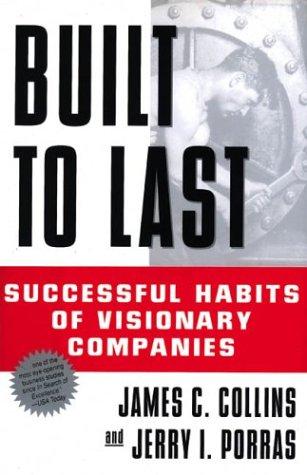
Collins and Porras's earlier study (predating Good to Great) compared 'visionary' companies against solid competitors to find what let some organisations thrive for generations. The answer centres on a core ideology that stays fixed while almost everything else — strategy, products, culture details — is free to evolve around it.
What the research actually did
Built to Last came out of a six-year Stanford project. Collins and Porras surveyed chief executives to nominate companies they considered genuinely visionary, ended up with eighteen — HP, 3M, Boeing, Disney, Merck, Sony, Marriott, Nordstrom, Procter & Gamble, Johnson & Johnson and others — and then did the thing that makes the book interesting: paired each with a comparison company founded in a similar era, in the same industry, with similar opportunities, that had done perfectly well without ever becoming iconic. Boeing against McDonnell Douglas. Motorola against Zenith. Marriott against Howard Johnson. The question wasn't 'what do successful companies do', which is a question with too many answers. It was 'what did this one do that its close rival didn't'.
The findings arrive largely as demolitions. It does not take a great idea to start a great company — 3M began as a failing mining venture and Sony's first product was a rice cooker that burned rice. It does not take a charismatic visionary leader; several of the comparison companies had far more magnetic founders. Profit maximisation was not the primary driver in the visionary group, though all were profitable. There is no common set of correct values — what mattered was having a core ideology and holding it, not what was in it. And the visionary companies overwhelmingly promoted from within: across the whole sample the authors found only a couple of instances of an outsider coming in as chief executive, against a much higher rate in the comparisons.
Clock building, and the Genius of the AND
The book's most quoted idea compresses its argument against founder-dependency into a single image. A great leader can tell you what time it is — make one brilliant call, launch one brilliant product. A leader who builds an organisation that keeps producing brilliant calls long after they've gone has built a clock. Collins and Porras found the enduring companies were disproportionately built by people obsessed with mechanisms: how decisions get made, how ideas surface, how successors get chosen, how the culture gets transmitted to somebody hired in twenty years' time. The comparison companies more often depended on the person at the top being right.
The second big idea is the Genius of the AND versus the Tyranny of the OR. The visionary companies refused the trade-offs everyone else accepted as given: purpose and profit, stability and change, conservative finances and audacious bets, tight culture and individual autonomy. Collins and Porras aren't claiming these are easy to hold together — they're claiming that the act of refusing to choose is itself the discriminating behaviour, because a company that accepts the trade-off stops looking for the arrangement that delivers both.
The mechanism that makes ideology real is what they call alignment: the small, unglamorous decisions that make the stated values expensive to ignore. Recruitment, promotion, what gets celebrated, what gets someone fired, how the office is laid out, what the bonus actually pays for. Their point about mission statements is blunt — writing one changes nothing; the visionary companies were distinguished by mechanisms that made the ideology consequential, not by the quality of the wording on the wall.
BHAGs, cult-like cultures and evolutionary progress
The Big Hairy Audacious Goal is the book's other lasting export: a commitment stated with enough clarity and ambition that everyone knows immediately whether it has been hit, big enough that reaching it requires the organisation to change. Boeing betting the company on the 707, at genuine risk to its survival if commercial jet travel hadn't materialised, is the central illustration — not an incremental target written in bold language, but a real stretch with real stakes and a finish line.
Cult-like culture is the finding that makes modern readers most uncomfortable, and the authors don't soften it. The visionary companies were not nice places for everybody to work. They had strong indoctrination, an unusually tight sense of who belongs, elitism about membership, and clear consequences for people who didn't fit. Nordstrom and Disney get used as examples of environments people either thrive in or leave quickly. The claim isn't that the culture was pleasant — it's that a company with an ideology it takes seriously will inevitably be a poor fit for a lot of capable people, and pretending otherwise weakens the ideology.
Then the counterweight: 'try a lot of stuff and keep what works'. Many of the visionary companies' best moves were not the product of strategic planning at all but of undirected experimentation followed by hard-nosed selection. 3M's Post-it note is the canonical example, and the company's genuine innovation was structural — permission to tinker, tolerance of failure, and a willingness to back whatever showed signs of life. Collins and Porras describe it as closer to biological evolution than to engineering: variation, selection, retention. That is a fundamentally different model of strategy from the one most planning still assumes, where the plan is meant to be correct before anyone starts.
Why it still matters, and what it asks of you
Read the two big ideas together and the book's actual instruction becomes clear. Decide, deliberately and in writing, on the very short list of things about your business that will not change even when changing them would be profitable — and then treat absolutely everything else as up for grabs, including products, pricing, structure, markets and the way you deliver. Most companies do the reverse without noticing: they abandon values under pressure and cling to a business model out of habit, because the model is what they can see and the ideology was never written down clearly enough to be missed.
It is a slower, less immediately actionable read than Good to Great, which Collins wrote later and which asks the prior question of how an ordinary company becomes one of these in the first place. Built to Last assumes you already intend to be around in fifty years and want to know what that requires structurally. For an owner thinking about succession, or about building something that outlasts their own energy, that is exactly the right question — and the clock-building chapter alone justifies the time.
Good enough never is, and the succession problem
Two of the book's less-quoted findings are the ones an owner-manager will feel most sharply. The first is what Collins and Porras call 'good enough never is' — the visionary companies built discomfort into themselves deliberately, in a way that had nothing to do with external pressure. They invested in capability well ahead of need, set internal standards nobody was demanding of them, and installed mechanisms whose entire purpose was to stop complacency taking hold in a good year. 3M's long-standing target that a substantial share of revenue should come from products introduced in the last few years is the classic example of a mechanism doing the work that willpower usually fails at.
The second is succession, and it is the finding that most directly contradicts modern management fashion. Across the visionary companies the authors found leadership was overwhelmingly home-grown: promoting from within was the norm, outsider chief executives were vanishingly rare, and the companies had explicit, often lengthy processes for developing and choosing the next generation. The comparison companies reached outside far more often, usually in a crisis, and the outsider then had to rediscover the ideology from scratch — or replaced it.
Put alongside clock building, that produces the book's real advice to a founder: the highest-value thing you can build is not a product or a market position but the machinery that keeps producing decisions consistent with what the business is for, and the machinery includes the person who takes over. Both findings are also the least comfortable, because they ask you to spend energy in good years on problems you don't have yet, which is precisely when nobody wants to.
Key lessons
- Enduring companies preserve a core ideology while stimulating progress and change in everything else.
- 'Clock building, not time telling' — build an organisation that keeps producing great outcomes, rather than being the one visionary leader with all the answers.
- Big Hairy Audacious Goals (BHAGs) commit an organisation to something concrete enough to genuinely stretch it.
- Try a lot of things and keep what works — evolutionary experimentation beats a single perfect master plan.
The companies that last aren't the ones with the best single strategy — they're the ones with a durable core purpose flexible enough to survive constant change around it.
What this means for a UK small business
Clock building is the idea with the sharpest edge for a UK owner-manager, because most small firms here are aggressively time-telling: the owner is the estimator, the closer, the relationship, the final quality check and the person who knows why the odd job is priced the way it is. That business is unsellable, and everyone finds this out at valuation. The practical test is a fortnight's holiday with the phone off. Whatever breaks is a mechanism you never built.
The 'preserve the core, stimulate progress' distinction deserves an honest afternoon. Write down the short list of things that genuinely wouldn't change even if keeping them cost money — how you treat people who make mistakes, what you refuse to sell, what you'd never bill for — separately from the services, pricing and delivery methods that are all fair game. Then check the alignment: if you claim to value quality but pay a bonus purely on volume, the bonus is your real value and everybody on the shop floor already knows it.
The evolutionary-progress idea is the most useful at small scale. Rather than betting a year's marketing budget on one carefully planned campaign, run four cheap variations at once — different offers, different channels, different messages — and put real money behind whichever one the market actually responds to, not the one that looked best in the meeting.
What’s aged well
The core ideology / stimulate progress framework remains a genuinely useful lens for long-term company building.
What feels outdated
As with Good to Great, several of the original 'visionary' case studies later ran into serious difficulty, which is worth bearing in mind as a caveat on the 'built to last forever' framing.
Where it falls short
The obvious problem is what happened next. Motorola was overtaken and broken up, Sony spent two decades losing categories it invented, Ford needed an emergency mortgage of its entire asset base to survive 2008, and Boeing's later safety and quality record is not the advertisement the book intended. Being built to last turned out to be less durable than the title promised — a point Collins himself half-conceded by writing How the Mighty Fall.
The method is also the target of the sharpest critique in the genre. Phil Rosenzweig's The Halo Effect argues that studies like this one mostly measure reputation: once a company is known to be successful, observers describe its culture, leadership and strategy in glowing terms, so the 'causes' identified are often just the halo of the outcome read backwards. Survivorship bias compounds it — nobody counted the companies that did all the same things and sank.
The Business Stuff verdict
Denser and less immediately practical than Good to Great, but a worthwhile companion for anyone thinking in decades rather than quarters.
Three things to actually do after reading it
- Write down your business's core purpose separately from your current strategy — check they're not the same thing.
- Set one genuine BHAG for the business, big enough to be uncomfortable.
- Identify one small experiment you could run this quarter rather than committing the whole business to a single bet.
If you liked this, read next
Five similar books
- Good to Great (Jim Collins)
- The Innovator's Dilemma (Clayton Christensen)
- Great by Choice (Jim Collins)
- Principles (Ray Dalio)
- Scaling Up (Verne Harnish)
Common questions
Should I read Built to Last or Good to Great first?
Read Good to Great first, despite Built to Last being written earlier. Collins has described Built to Last as effectively the sequel in terms of what it asks: it studies companies that were already exceptional and explains what let them stay that way for decades. Good to Great asks the question almost every reader actually has, which is how an ordinary company becomes one of those in the first place. It is also the tighter book and the more practical one for an owner-manager. Come back to Built to Last when you're thinking about succession, longevity or what the business looks like without you in it — that is where it earns its place.
Does it matter that several of the 'visionary' companies later struggled?
It matters a great deal to the title's claim and rather less to the book's usable content. Motorola, Sony and Ford all had serious falls after publication, and Boeing's later record undercuts the book's most famous BHAG example. That is fatal to any reading of Built to Last as proof of a durable formula. What survives is the diagnostic: clock building versus time telling is a genuinely useful question about your own dependency on yourself, and the preserve-the-core-stimulate-progress distinction is useful whether or not the eighteen companies stayed on top. Read it as a set of good questions, not as evidence.
Is the BHAG idea usable in a small business, or is it corporate theatre?
It's usable, but only if the goal has a finish line and real stakes. The failure mode in small firms is a BHAG that is really a slogan — 'be the best-known agency in the North West' — which nobody can score and nobody has to risk anything for. A usable version names a number and a date and implies things you'll have to stop doing: forty retained clients by 2030, or every job delivered without a site visit from the owner. If achieving it wouldn't require the business to change shape, it isn't a BHAG, it's a forecast with adjectives.
How long does it take to read?
Around nine to eleven hours for the full text, and it is denser going than Good to Great — long research passages, extensive company histories and a fair amount of repetition between chapters. If you're short of time, the introduction plus the chapters on clock building, core ideology, BHAGs and evolutionary progress carry most of the argument, and the paired company histories can be skimmed once you've grasped the method. The appendices explaining the research design are worth ten minutes if you want to judge how much weight the conclusions can bear, because that is where the book's main vulnerability sits.